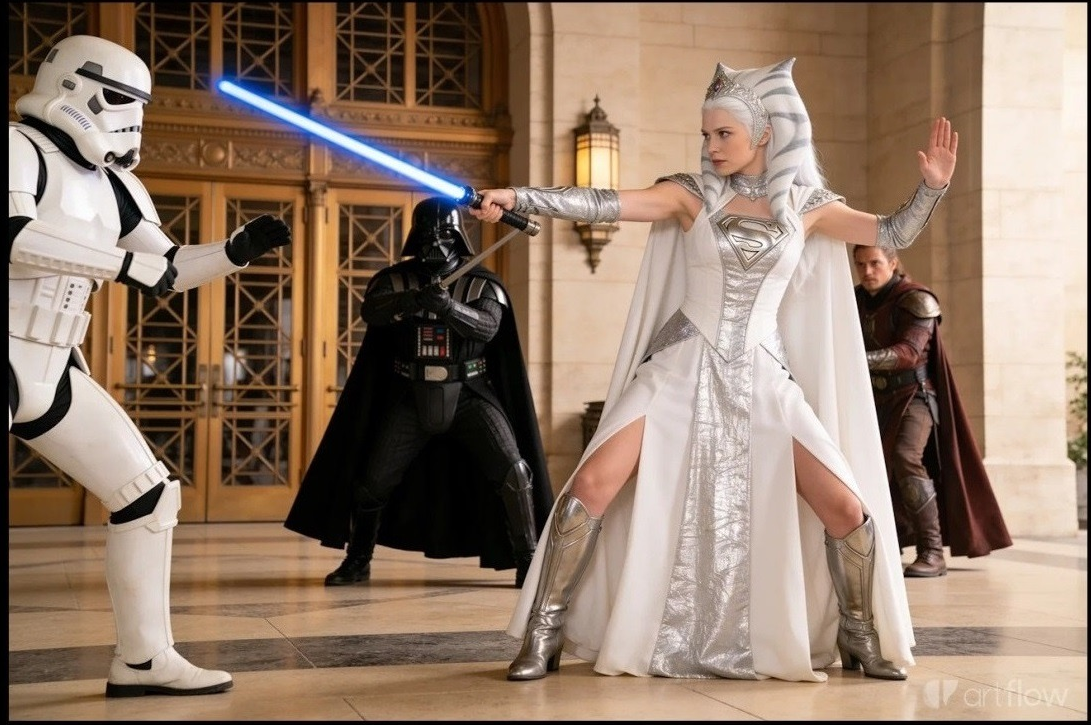
America! A land where the Protestant workbench collides head‑on with the Hollywood dream machine. Out of the cornfields and the soundstages, out of the soldering irons and the laser pistols, comes a new creed—half silicon, half stardust. This is the saga of how the tinkerer became the prophet, how the movie myth became the manual, and how the glowing rectangle became the altar of a brand‑new faith.
EPISODE I: GRINNELL AND THE BIGGIES OF FIFTY-SEVENTH STREET

In 1948, if you happened to find yourself in Grinnell, Iowa, you were breathing an air so thick with Dissenting Protestantism you could practically slice it and serve it with a side of potatoes.
This particularly meant a traditional culture of asceticism and enlightened rationality.
There were still folks walking around who kept such a covenant to death. No liquor. No ostentation! In Grinnell, there were only two kinds of people: those who were hardworking, God-fearing, and educated, and those who… well, let’s not talk about *them*.
To show off wealth in Grinnell was a social blunder of catastrophic proportions. You didn’t take tennis lessons; you worked odd jobs. You didn’t hire a repairman; you *tinkered*. And it was out of this very soil, this non-hierarchical, self-reliant, “make-it-yourself-because-nobody-is-coming-to-help-you” Protestant ether, that Robert Norton Noyce emerged.
With the Gary Cooper chin and the “halo effect”—that baffling, serene confidence that made everyone around him want to stand up a little straighter and follow him into the fire.
With little problem one day he became an MIT PhD, yes, but at his core, he was a *tinker*, and so he was one of the pioneers in the development of the solid transistor (which allowed the arrival of the portable radios).
In 1956, William Shockley—the Nobel laureate himself, the genius, the mad emperor of the semiconductor—pitched his tent in the sleepy apricot orchards of Mountain View, planting the seed that would soon sprout into the Valley’s empire of silicon prophets! But working under Shockley was no day at the parish picnic. The old man ran his laboratory like a paranoid feudal fiefdom, endlessly inspecting, mistrusting, and smothering the very brilliance he had gathered around him.
The situation cracked under the weight of the old man’s tyranny, and so Noyce and seven other young hotshots—the “Traitorous Eight”—did something absolutely unthinkable to the Eastern corporate mind. They walked. They didn’t just walk; they leaped into the great, brown, sun-baked hills of the Santa Clara Valley and began to play a wild, high-stakes game of corporate musical chairs. –
Soon their Great Silicon Hopscotch started plowing the field for the birth of Silicon Valley itself!
Who was paying for all this? Ah. This is where the Great Midwestern Dissenting Protestant met the Great Eastern Aristocracy. One day, John Carter—the big-time Chief Executive Officer of Fairchild Camera and Instrument back in New York—decides to finance the adventurers.
Noyce and his Merry Men set up Fairchild Semiconductor. Then some left Fairchild to start Amelco. Others left to start Signetics, National Semiconductor, AMD. They were spinning off like protons in a cyclotron! Fifty-some-odd companies—the “Fairchild Children”—budding off the parent stem. And with every hop, skip, and jump across the valley, they changed the very geometry of the game:
-1959- Noyce etches a whole herd of transistors onto a single, flat sliver of silicon. The integrated circuit! The *microchip*!
-1968- Noyce and Gordon Moore leave Fairchild to start Intel.
-1971- Under Noyce’s watch, Ted Hoff squeezes an entire central processing unit (CPU)—the computer’s brain—onto a single chip. The microprocessor!
Intel was in the house now! And right then and there — with a flash of silicon lightning and a thunderclap of pure American hustle — the whole mad, glorious, open-collared culture of Silicon Valley was born.
They were making millions with every square they advanced on this dry-grass chessboard. But they weren’t buying yachts. They weren’t buying mansions in Newport. No, they were wearing open-collared shirts, working eighty-hour weeks until their backs went into spasms, and then heading over to the Wagon Wheel bar to argue about “parasitic signals” and “phase jitters” over cold beers.
Noyce banned the reserved parking spaces. First come, first served—if you’re late, you park in the back forty, even if you’re the president. He tore down the baronial office suites. He set up open cubicles. He kept the doors open. He threw away his tie. He was going to change the world—but he was going to do it with the soul of a Grinnell tinkerer who didn’t owe a damn thing to the status-obsessed aristocrats of New York.
EPISODE II: THE FORCE AND THE FEEDBACK LOOP
Now, while Robert Noyce was out there in the high-voltage orchards of Northern California, boiling down the universe into tiny, microscopically etched wafers of grey silicon, a parallel track was warming up. A second engine of the new American consciousness was revving its cylinders some three hundred miles south down Highway 101.
In *Hollywood*. Yes! Hollywood! That great, sun-bleached basin of make-believe where they didn’t manufacture microchips; they manufactured *mythology*. The year is 1977. The air in Los Angeles is thick with leaded gasoline exhaust and the sweet, musky scent of patchouli oil. And suddenly, in May of that year, a strange, roaring sound begins to emanate from the movie houses. It isn’t just the sound of Dolby Stereo—it is the sound of an entire generation’s collective skull being cracked wide open. *Star Wars!* Before this, science fiction on the silver screen was cold. It was sterile. It was Stanley Kubrick’s pristine white spaceships drifting silently through a vacuum to the strains of Johann Strauss, or it was some bleak, dystopian warning about how we were all going to end up eating green crackers made of recycled citizens. But this? This was something altogether different. This was *used*. It was dusty! It was dented! The spaceships had grease stains on the engine cowlings! And at the center of it all was a piece of junk. But oh, what a piece of junk! The *Millennium Falcon*.
It wasn’t a sleek, state-sponsored rocket. It was a hot rod! It was a souped-up, fuel-injected, triple-carbureted tramp freighter that could make .5 past lightspeed. It was the ultimate vehicle for the ultimate fantasy: hovering, swashbuckling across the stars, dodging asteroids, saving a princess with a laser pistol on your hip, and making her yours because you had the brass, the nerve, and the fastest ship in the sector. It was Robin Hood in a leather vest, operating out of a dirty cockpit with a hairy, eight-foot-tall co-pilot.
The Great Toy Epidemic
And the country went absolutely, hopelessly stark raving mad for it.
It was a cultural landslide that swallowed up the children first, but then—smirabile dictu! *—the adults couldn’t escape either. It wasn’t just a movie anymore. It was an ecosystem. There were colorful, glossy magazines. There were fan clubs. And above all, there were the *things*. The objects! The Kenner action figures! Little three-and-three-quarter-inch pieces of molded plastic that suddenly became more valuable than gold bullion in the schoolyards of America.
You had to have them all. You had to have the shiny, gold-plated robot, the blue-and-white dome-topped trashcan of a droid, the little plastic laser swords that would bend if you stepped on them. The living rooms of the middle class were transformed into miniature desert planets and plastic star cruisers.
But there was something else happening under the hood of this phenomenon. Something far more potent than mere toys. – The Invisible Miracle On that screen, we weren’t just watching high-tech gadgetry. We were watching humans—well, farm boys and old desert hermits—who were capable of things that bypassed the laws of physics entirely. They didn’t need calculators. They didn’t need targeting computers. In the climactic moment, the boy actually *turns off* his targeting screen! He closes his eyes! “He trusts the Force.* And—*zap!*—the torpedoes hit the thermal exhaust port, right on the stoney, a mere afterthought. These characters had uncanny, godlike feats. They could move heavy metallic objects with a wave of a hand. They could foresee the future in sudden, shivering visions. They could read minds across cold star systems. It was a mystical revolution. It put the old-school comic book heroes to shame.
Superman was a bore—he had to be born on Krypton and wear blue tights to fly. But this? This “Force” was something *anyone* could tap into if they just cleared their mind and felt the energy flow. It was the ultimate Me-Decade spiritualism merged with the loudest, flashiest, most intoxicating space opera ever devised.
And back in the Santa Clara Valley, those young engineers — fresh from their soldering irons and all-night debug sessions — sat in the dark theaters, eyes wide as saucers, watching those dirty, dented, gloriously lived-in spaceships and those glowing vector screens. They didn’t just see a movie. They saw a new religion being born in real time. It wasn’t only about collecting the novelizations and the action figures. By 1987 the official Star Wars RPG rulebooks had arrived, thick as phone directories, and the faithful could finally imagine with their mind’s eye — a whole new splintered faith, half circuit board, half mystic Force.
EPISODE III: THE DE-DEIFICATION AND THE GLOWING RECTANGLE
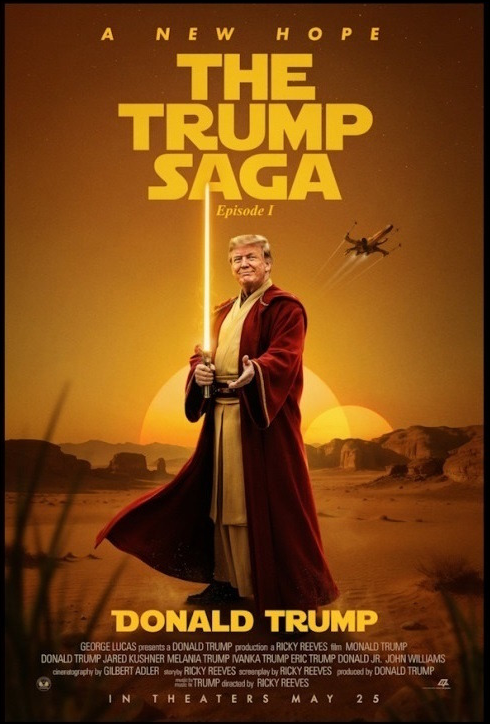
Now, let us pan our cameras back to the Great Silicon Valley flatlands, because by the time the calendar rolled into 1985, something… *extraordinary*”. was bubbling up through the floorboards. We weren’t just talking about engineering anymore. We weren’t just talking about a bunch of clever technicians sliding chips into plastic boards to help the banks of Zurich keep track of their interest rates. No! We were talking about a full-scale, high-fidelity, warp-speed cultural revolution. For decades, the computer had been the exclusive, terrifying mascot of the ultimate Corporate Biggie: -IBM-.
Ah, International Business Machines! The very name sounded like a gray steel vault. IBM was the domain of the white-shirted, blue-suited, dark-tied, wing-tipped, crew-cut corporate priesthood. They were the boring, colorless, mechanical monks of Wall Street. Under their watchful eyes, the computer was a giant, freezing, humming room-sized monster called a Mainframe. Its only job? To calculate the massive, cold, decimal-pointed balance sheets of the world’s elite banks. It was an instrument of sheer, impersonal authority. It looked at you, the individual, and saw nothing but a nine-digit Social Security number punched into a stiff cardboard card: *Do Not Fold, Spindle, or Mutilate!*
But then, Intel—under the nose of those very same New York bankers—began pumping out those tiny microprocessors. And suddenly, the power didn’t belong to the corporate priesthood anymore. It belonged to the *kids*. – The Glow of the New Cathedral Walk down any suburban street in America in 1982. What do you hear? You don’t hear the church bells. No! You hear *beep-beep-bloop-bzzzzztr* It was the sound of the arcades! The kids were dropping millions of quarters into glowing plywood altars. But right next door to the arcades, a quiet, even more radical transformation was happening in the den. Intel’s microchips were bringing basic images and text right onto the home screen. These weren’t boring columns of corporate ledger data. This was *intelligent entertainment*. You slipped a five-and-a-quarter-inch floppy disk into your drive, and—*whirrrrr-clack-clacr*—the green phosphorescent screen flared to life. And what did you see? You didn’t see a spreadsheet. You saw a prompt. A doorway.
The Great Protestant Blur
And right here, the old, rock-solid, Midwest-Dissenting Protestant principles of Saint Robert Noyce’s youth began to twist, bend, and dissolve into sheer, unadulterated disbelief. For three hundred years, the American character had been anchored by a very specific, serious, self-denying, Protestant God. Jesus was the ultimate authority. You worked hard, you kept your head down, you served your community, and you waited for your reward in the next life. You were a servant of the Lord. But now? Jesus was being quietly, systematically, and spectacularly *dethroned*. And who was entering the empty sanctuary to take His place? “You.”
Yes! *You yourself!* Like that giant, top-hatted Uncle Sam on the old recruiting posters, the machine was pointing its electronic finger right through the glass, straight at your chest, and saying: *I WANT YOU… to be a god!*
And now—kaboom!—you had it in your very own living room! In 1977, the exact same year Star Wars blew the lid off the collective American skull, Steve Wozniak and Steve Jobs—two open-collared, wild-eyed California hotshots—spawned the Apple II right out of a garage in Silicon Valley and unleashed it upon an unsuspecting world! It was the world’s first honest-to-God mass-market personal computer, a gleaming, off-white plastic pod pulsing with full-color graphics and built-in sound—not for the cold, gray, wing-tipped corporate priesthood of IBM, mind you, but for the hobbyists, the visionaries, the tinkerers! Suddenly, every middle-class suburbanite in America had his very own Millennium Falcon sitting right there on his desk, an unbelievable, high-tech cockpit bursting with keyboards, joysticks, paddles, and game controllers!
Suddenly, you weren’t just a spectator in life. You weren’t just a quiet, obedient cog in the great social machinery of the Republic. No! You slipped that disk in, and you were a *Hobbit*, packing your digital elven bread and wandering through the dark, pixelated forests of Middle-earth, fighting off spiders with a sword that glowed blue! Or you were *Indiana Jones*, wearing the brown fedora, swinging across bottomless chasms with a whip, dodging poison darts, and snatching the golden idol from its stone pedestal! Or—finally, mercifully!—you were a *soccer superstar*, weaving past defenders, executing a flawless bicycle kick, and sending thirty thousand simulated fans into a roaring, digital ecstasy in the final second of the match! You were animated to life! You were the hero, the savior, the king, the conqueror.
The microchip had taken all the wild, swashbuckling, mystical space-fantasies of Hollywood and poured them directly into a box that sat on your desk. The old world had demanded that you submit to the system. The new silicon world told you that you *were* the system. You didn’t need to pray for a miracle anymore. You just had to hit *Enter*.
EPISODE IV: THE JEDI OF THE SILICON VALLEY AND THE CURVE ON HIGHWAY 17

And then, with the dawn of the 1990s, the final, supreme transformation took place. If Robert Noyce’s early microchips were the kindling, and the Apple II was a merry little campfire, then Intel’s Pentium processor (Noyce’s grand grand brainchild) was a roaring, thermonuclear blast of pure, raw computational speed. Three million transistors! Squeezed onto a wafer no larger than a postage stamp! This wasn’t just a technical upgrade; it was a metaphysical threshold.
The old, plodding world of Protestant salvation—where you worked with quiet, dusty humility, hoping to cross the River Jordan with a sober escort of angels, entering the temple only through the strictly monitored East Gates, walking behind a humble fisher of men—was gone. Vaporized!
With the Pentium, you didn’t follow a master. You *were* the master. Suddenly, you were sitting in a dark bedroom in New York, clutching a plastic joystick, but your mind was light-years away, navigating the corridors of an Imperial Star Destroyer.
The Big Bang of Style
In the late 1980s, George Lucas’s digital sorcerers over at LucasArts uncorked a whole new genre of interactive wizardry, kicking the door off its hinges with Maniac Mansion! No more typing dry, pedantic line-by-line commands into a monochrome terminal—no! You just point the cursor, click click-click-click, and warp reality right on the CRT glass!
It was a triumph of pure, unadulterated California cool, and it brought the studio’s young code-junkies straight out of the suburban shadows and into the high-rent promised land: Skywalker Ranch itself! There, sprawling among the lush, sun-dappled, golden hills of Marin County (also in Frisco over the north side of the bay), Lucas began marshaling the most terrifying computational firepower money could buy—not just to forge cinematic eye-candy for the multiplexes, mind you, but to supercharge his high-tech entertainment empire, spearheaded by the neck-snapping, gut-churning motion-simulator thrills of Star Tours over at Disneyland!
And then—zap!—by the turn of the decade, the Ranch’s mad technicians were secretly cooking up something even more radical: a wild, networked, multi-player dogfight simulator! It was a proto-virtual-reality sky-war! A high-stakes, digital dogfight that promised to pit real-world players head-to-head in the cockpits of X-Wings and TIE Fighters long before the rest of the world had even heard of an IP address! But alas—it was too far ahead of its time! Too greedy for processing speed! Too expensive for the timid, wing-tipped money-men back east to swallow! And so—poof!—the project was shelved, left to gather dust in the vault until the rest of human technology could finally catch up to the dream!
In 1995 nonetheless, LucasArts unleashed *Dark Forces”, followed by *X-Wing* and *Jedi Knight*. It was a big bang of a style in home entertainment. Other computer games of the era—*Doom*, with its splattery, adrenaline-soaked labyrinth of demons, or *Civilization*, with its slow, dry, intellectual chess game of empire-building—were massive hits, yes. But they lacked the one thing that made the Silicon Valley crowd fall to their knees. They lacked *mysticism*. They lacked *the Force*.
*X-Wing* let you finish off the Death Star yourself — the ultimate 1990s bucket-list item, a boyhood dream turned pixelated holy war. *Dark Forces* went even further: one day it dropped as shareware, and suddenly you were storming Imperial bases, stealing the plans to Vader’s ultimate weapon, and blasting your way out past squadrons of stormtroopers. At that point the minds of Silicon Valley were melting in pure, uncut childhood ecstasy.
In *Jedi Knight*, you weren’t just clicking buttons to accumulate points. You were training. You were mastering the light side or the dark side of your own internal energy. And for the first time in human history, you weren’t doing it alone in a room. Through the magic of early dial-up multiplayer networks, you ignited your virtual lightsaber in New York and clashed with an opponent sitting in Sydney, Australia. In a single, seamless, instantaneous match across the belly of the globe!
The tech-elite had built their own church out of fiber-optic cables and silicon. You were your own religion now, and with the Pentium running your universe, you were ready to prove your divinity to the rest of the world. –
A New California Faith
And what about the human beings who built this paradise? By the mid-90s, the new tech-millionaires of California had evolved a sociology all their own. Traditional religion? Church on Sunday? The quiet, modest Congregationalism of Robert Noyce’s Iowa? *Forget it!* In the Valley, traditional religion was used for exactly one thing: a scenic backdrop for a lavish, multi-million-dollar wedding, right before the inevitable, spectacularly messy divorce. And then another wedding. And another divorce. They had no time for the old sins and the old salvation. They had better things to do. They were busy buying their own private Gulfstream jets to fly around the globe. But even when they were on the ground, they furnished their massive, empty, minimalist mansions with high-powered Pentium rigs just to escape the physical world entirely—to fly to a galaxy far, far away. Their minds stretched like a waking giant. They were living in a high-speed, frictionless paradise of their own creation.
Robert Noyce—who had passed away in 1990—became the ultimate departed Jedi of this world. He was the one who had believed in the Force of human ingenuity, submerged in the very virtual world he himself had spent decades inventing.
But there was a hitch. A tiny, terrifying glitch in the grand system. – The Dark Side of the Force For all their godlike power, for all their millions, these new emperors of the microchip were still made of meat, bone, and blood. And one day, the real world came rushing back to remind them.
It happened on the very day that one of the Valley’s hottest new firms, Eagle Computer, Inc., sprang its IPO—its Initial Public Offering—onto the stock market. The investors went absolutely wild for it, snapping up shares like they were the answer to some ancient, aching human dream.
At the close of trading on the stock market, the company’s forty-year-old Chief Executive Officer, Dennis Barnhart, found himself transformed in a single afternoon from a hardworking tech-hustler into a man worth a cool nine million dollars. Nine million!
Four and a half hours later, Barnhart and a pal took his brand-new, gleaming, red Ferrari out for a little romp. They wanted to feel the speed. They wanted to test the physical limits of their new universe. They hung their hides out over the edge, roaring down the tarmac, until they lost control on a sharp, treacherous curve in Los Gatos. The Ferrari went through the guardrail. The metal crumpled. The fiberglass shattered. And Barnhart was killed instantly.
Naturally, that night, at the bars, the restaurants, and the open-plan offices across the Valley, people in the business could talk of very little else. The nine-million-dollar man, gone before the ink on his stock certificates was even dry!
One of the best-known CEOs in the Valley sat with his drink, looked at his colleagues, and said: “It’s the dark side of the Force.” He said it without a single trace of irony. He said it as if he were quoting scripture. And around the table, his friends simply nodded in quiet, solemn contemplation. They had no scientific term for what had happened on that curve in Los Gatos. They had no equations to explain the sudden, brutal intersection of nine million dollars and a guardrail. But they didn’t need one.
They knew exactly what Force he meant. They were living it at full throttle.




Leave a Reply