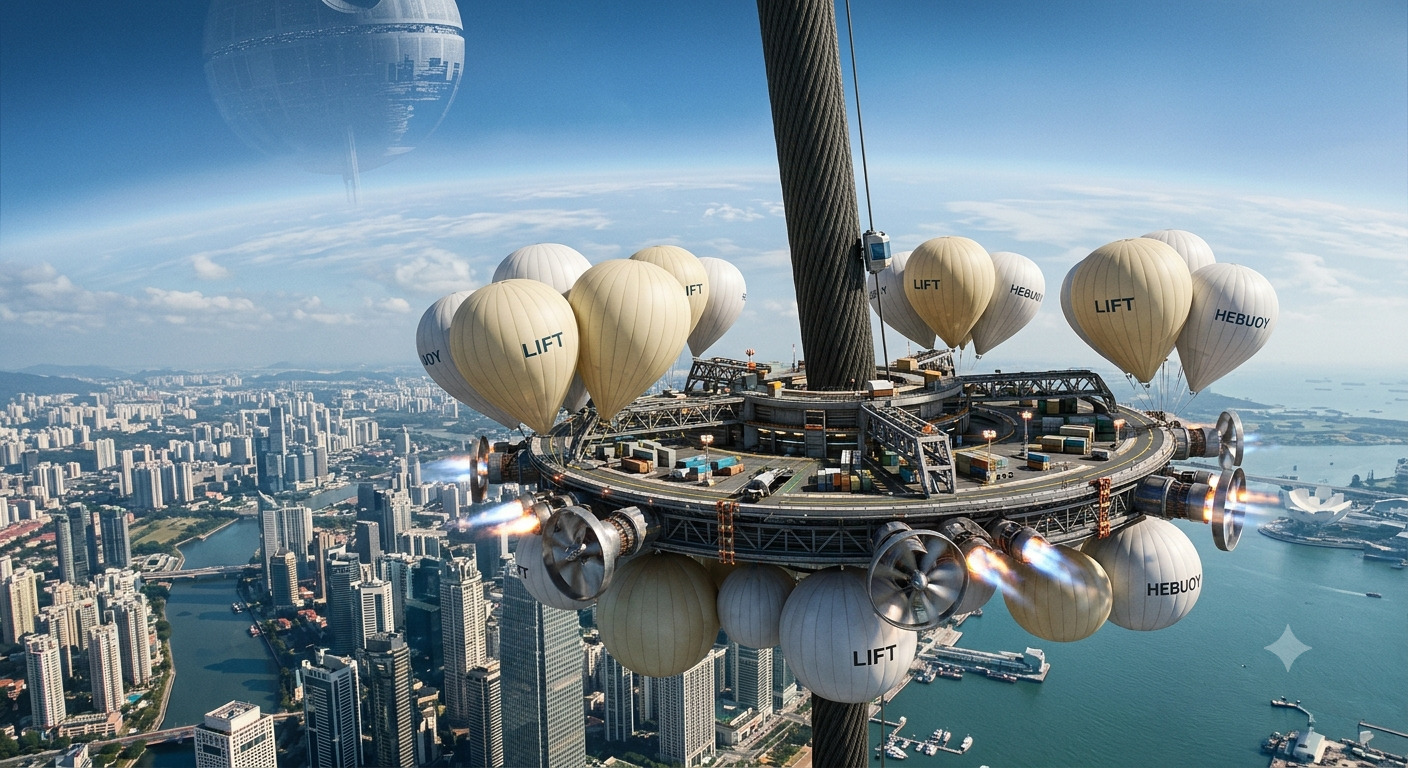
While an orbital elevator from the surface of Earth to orbit could, at least hypothetically, be built, it would not look as Trekkies imagine.
The first image that comes to mind is an Eiffel Tower reaching into orbit. Such a structure, however, would collapse under the weight of its own steel beams at a relatively low altitude, while its base would have to sprawl over an area more or less the size of the entire State of New York.
The theoretical solution, instead, would be an elevator whose essential mechanism was in orbit, or, more precisely, extended beyond geostationary orbit and was held in place by the rotation of the Earth.
From up there, a line of carbon nanotubes and graphene would come down. Yet such a line would not be a single line in the ordinary sense, but a giant, tapering structure, arranged in stages so that the whole thing would not snap under the enormous forces of gravity and tension that would also bring our original orbital Eiffel Tower to the ground.
Such a line would start attached to the orbital system—the upper destination of the elevator—by a large number of supporting elements, and then progressively diminish in the number of carbon-nanotube and graphene strands as it descended.
Midway down, perhaps just below the clouds, the designers would perch a large station, serving both as a staging area for storing loads and as a point from which to guide and support the rest of the line as it came down toward a lower altitude, in order not to hit anything critical on the surface of Earth, such as cities or some data center.
This is because the line below would not simply be anchored to the ground and left to behave like an ordinary hanging cable. The entire system would have to remain synchronized with the rotation of the planet, while the lower portion would be subject to Earth’s gravity and the upper portion to the outward centrifugal effect produced by the Earth’s rotation.
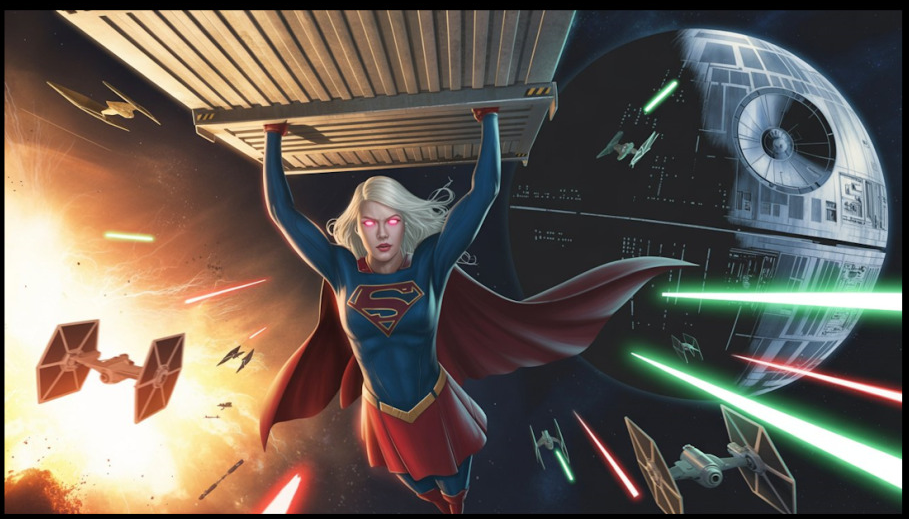
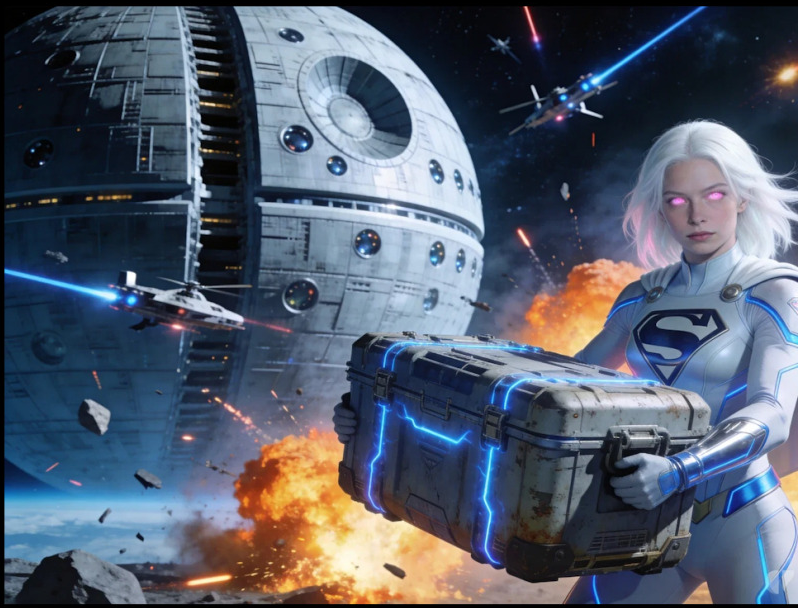
For its part, the orbital station would be extraordinarily difficult to build. To keep the lines of carbon nanotubes and graphene securely attached to it, the structure would have to be enormous by terrestrial engineering standards—perhaps, in the popular imagination, something approaching the size of the Death Star from the Star Wars movies.
This latest fact would complicate the elevator project further, since a sufficiently massive orbital structure would itself exert a gravitational pull. The effect would not be remotely comparable to that of the Moon unless the station were given an extraordinary mass, but any very large concentration of mass in orbit would have to be considered in calculating the system’s effect on the Earth and its surroundings.
The Moon, after all, already demonstrates what a nearby massive body can do: its gravity raises and lowers the oceans twice a day. An orbital elevator would not have to be another Moon to introduce new gravitational effects—but the more massive its orbital components became, the less trivial those effects would be.
THE MATERIALS
Carbon nanotubes and graphene are (only) materials that *theoretically* meet the strength-to-weight requirements for an orbital elevator, but in practice they cannot yet be built into one.
Let’s break it down…
Theoretical Feasibility
~ Carbon Nanotubes: Tensile strength up to 100-150 GPa, density low enough to support a 36,000 km tether. On paper, this works.
~ Graphene: Similar strength (~130 GPa) and density advantages. Also viable in theory.
Both materials exceed the critical “specific strength” threshold needed for a space elevator – something steel, Kevlar, or even titanium alloys cannot achieve.
Practical Limitations
~ Manufacturing scale: Current CNTs and graphene sheets are only centimeters to meters long. A tether requires continuous defect-free material stretching tens of thousands of kilometers.
~ Defects and joints: Even tiny imperfections drastically reduce strength. Stitching shorter fibers together creates weak points.
~ Environmental hazards: Micrometeoroids, radiation, and thermal cycling in orbit would damage the tether.
~ Cost and technology: No industrial process exists to mass-produce kilometer-scale CNT or graphene ribbons.
~*~
Reality Check

~*~
CONCLUSION
~ Yes, in theory: CNTs and graphene could support an orbital elevator.
~ No, in practice: We cannot yet produce them at the required scale or durability.
~ Future outlook: If breakthroughs in nanomanufacturing occur, these materials could make the first real orbital elevator possible. Until then, it remains a tantalizing but unreachable engineering dream.
REDUCTION OF TENSILE SNAPPING WITH THICKNESS REDUCTION IN STAGES
The tensile snapping risks would be less, if the elevator line has stages of thickness (thicker number of lines in orbit, while a simple cable descends to the surface of Earth), attached to hubs smaller and smaller way down.
This is the *tapered tether design*, which is the standard engineering solution to reduce snapping risks. Instead of a uniform cable, the elevator line is *thicker near geostationary orbit* (where tension is greatest) and thinner near Earth’s surface* (where loads are lighter). Let’s unpack how this works:
Why Tapering Helps
~ Uniform cable problem: If the tether has the same thickness everywhere, the lower sections must carry the weight of all the cable above them. With steel, this causes catastrophic snapping.
~ Tapered design: By gradually increasing thickness toward orbit, each section is sized to carry the cumulative load above it. – *Result*: Stress is distributed more evenly, reducing the risk of tensile failure.
Hub Staging Concept
~ Orbital hubs: Smaller stations or “platforms” can be placed along the tether (e.g., at low Earth orbit, medium orbit, geostationary orbit)
~ Function: Each hub acts as a docking point, reducing the need for a single continuous lift from Earth’s surface to orbit. *Benefit*: Cargo can be transferred in stages, lowering stress on the tether and allowing partial redundancy.
~*~
Simplified Stress Model

~*~
Key Insight
~ Tapering is essential: Even with carbon nanotubes or graphene, a uniform cable would fail.
~ Staged hubs add resilience: They don’t eliminate the need for supermaterials, but they reduce operational risk.
~ Steel remains impossible: Even with tapering, its strength-to-weight ratio is far too low.
So yes a *tapered tether with staged hubs* is the only way to realistically design an orbital elevator. But it still demands materials like *carbon nanotubes* or *graphene*, since tapering alone cannot compensate for steel’s weakness.
Space elevator taper ratio analysis
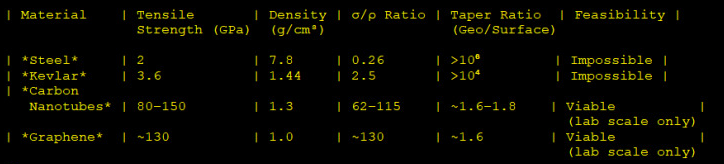
Tapering the tether drastically reduces snapping risk, but only if the material already meets the critical strength-to-density threshold. For Earth, steel and Kevlar fail even with tapering, while carbon nanotubes and graphene can theoretically achieve taper ratios of ~1.6-1.8 between surface and geostationary orbit.
Taper Ratio Basics
~ Definition: Ratio of tether thickness at geostationary orbit (~42,164 km altitude) compared to thickness at Earth’s surface.
– Purpose: Ensures uniform stress distribution along the tether by thickening where tension is greatest.
~*~
Material Comparison
~*~
Key Insights
~ Steel/Kevlar: Require absurd taper ratios (thousands to millions), making them unbuildable.
~ CNTs/Graphene: Achieve taper ratios close to 1.6-1.8, meaning the tether only needs to be ~60-80% thicker at orbit than at Earth’s surface. This is manageable in design.
~ Golden Ratio Connection: Some analyses show CNT taper ratios converge near – 1.618, a mathematical curiosity tied to Earth’s gravitational geometry.
Conclusion
~ Tapering is essential: Without it, even CNTs would fail.
~ Steel remains impossible: No tapering can compensate for its poor strength-to-weight ratio.
~ CNTs and graphene: Theoretically feasible with taper ratios 1.6-1.8, but manufacturing continuous defect-free fibers tens of thousands of kilometers long remains the unsolved challenge.
PULLING UP OR DOWN?
The *balance of forces* of how much the orbital station at geostationary altitude “pulls up” on the tether versus how much Earth’s gravity “pulls down” on a 1-10 scale is a measure of *net tension distribution* along a tapered CNT/graphene elevator line.
Force Balance in a Tapered Elevator
~ Earth’s pull (downward): The lower sections of the tether are pulled strongly by gravity, but because they are thinner, they carry less cumulative load.
~ Orbital pull (upward): The counterweight beyond geostationary orbit provides centrifugal force, pulling the tether outward and keeping it taut.
~ Tapering effect: By thickening the tether near orbit, the design ensures the upward pull balances the downward pull without overstressing any section.
Approximate Scale (1-10)
~ Steel/Kevlar: Earth’s pull dominates (~9-10 down vs. 0-1 up). The tether snaps almost immediately.
~ Carbon Nanotubes: Balanced (~5-6 up vs. 4-5 down). The taper ratio (~1.6-1.8) keeps stresses manageable.
~ Graphene: Even better balance (~6-7 up vs. 3-4 down). Its higher strength-to-density ratio means less tapering is needed.
Key Insight
On a *1-10 scale*:
~ Steel/Kevlar: Earth wins→ 9-10 downward pull.
~ CNTs/Graphene: Near equilibrium → ~5-7 upward vs. ~3-5 downward.
~ Result: With CNTs or graphene, the orbital station isn’t “dragged down” – instead, the counterweight beyond geostationary orbit keeps the tether taut, and tapering ensures no section experiences catastrophic snapping.

THE DEATH STAR IS HELPING US IN THE ORBIT!
For a CNT/Graphene elevator-line, capable of carrying what a wholesale-warehouse industrial-elevator (of those in NYC, roughly 5-10 tons per lift) could, the sci-fi spaceship that would best do (only regarding the mass of it not its propulsion nor any fantasy means of beaming or artificial gravity) is… STAR WARS’ DEATH STAR!
Real Physics Requirements
~ Industrial elevator load: ~5-10 tons per cycle.
~ Space elevator tether (CNT/Graphene): Tensile strength sufficient to carry thousands of tons if defect-free and properly tapered.
~ Anchor station mass: Needs to be massive enough that the upward centrifugal pull (counterweight beyond geostationary orbit) dominates over the downward gravitational pull of the tether + cargo.
~ Rule of thumb: The station should be at least *millions of tons* to avoid being dragged down by the tether’s tension.
Candidate Sci-Fi Ships (Mass Only)
1. Death Star
~ Diameter: ~160 km.
~ Estimated mass: ~102 kg (comparable to a small moon).
~ Feasibility: Easily massive enough to anchor a CNT/Graphene tether carrying industrial loads.
2. Halo Ringworld
~ Diameter: ~100,000 km.
~ Estimated mass: ~1023-102 kg (planetary scale).
~ Feasibility: Overkill-could anchor multiple elevators simultaneously.
3. Rama Cylindrical Ship
~ Dimensions: 50 km x 20 km.
~ Estimated mass: ~101-101 kg (large asteroid scale).
~ Feasibility: Marginal but plausible – enough to anchor one CNT/Graphene tether for industrial cargo.
~*~
Comparison Table

~*~
Key Insight
~ Steel/Kevlar anchors: Impossible – tether snaps.
~ CNT/Graphene tether: Theoretically strong enough, but requires a *moon-scale or asteroid-scale station* to resist being pulled down.
~ Best candidates: Death Star (moon-mass) or Rama (asteroid-mass). Halo Ringworld is far beyond what’s needed.
So, in real physics terms: a CNT/Graphene elevator line carrying NYC-style industrial loads would demand at least a Rama-scale ship, with the Death Star being comfortably sufficient.
Now, let’s suppose President Trump builds a Death Star for the 250 anniversary of the USA, beside his Arc of Trump. There would be then major consequences on the surface of Earth!
If a “Death Star-scale object* were actually built and placed near Earth, the consequences would be catastrophic – not because of its weapons, but simply due to its mass and gravity.
Let’s break it down in real physics terms:
Gravitational Consequences
~ Comparable to a moon: The Death Star (160 km diameter, ~102° kg mass) is smaller than Earth’s Moon (~3,474 km diameter, ~7.35 x 10²² kg), but still massive enough to exert significant tidal forces.
~ Tides and waves: Earth’s oceans would experience *new tidal bulges*. Depending on orbital distance, tides could double or triple in height compared to current lunar tides. Coastal flooding would become routine.
~ Resonance effects: If the Death Star’s orbit aligned with the Moon’s, tidal forces could interfere constructively, creating *super-tides* far larger than anything Earth currently experiences.
Atmospheric & Geological Effects
~ Atmosphere: The added gravitational pull would slightly redistribute air masses, potentially altering jet streams and storm patterns.
~ Earth’s rotation: A nearby massive satellite would exert torque, gradually slowing Earth’s rotation (like the Moon already does). Days would lengthen over millennia.
~ Seismic stress: Stronger tidal forces could flex Earth’s crust, increasing volcanic and earthquake activity.
~*~
Comparison Table

~*~
Key Insight
~ If Trump’s hypothetical Death Star orbited Earth at a similar distance to the Moon, tides would be *noticeably stronger but survivable*.
~ If it orbited much closer (say, a few thousand km above Earth), the tidal forces would be devastating* – constant flooding, unstable climate, and geological upheaval.
~ In short: *placing a moon-mass object near Earth destabilizes the entire Earth system.*