Tag: technology

  • THE AI HACKER THREAT – WHAT’S LEFT FOR US: TRADITIONAL BANKING OR BITCOINS?

    THE AI HACKER THREAT – WHAT’S LEFT FOR US: TRADITIONAL BANKING OR BITCOINS?

    In the autumn of 2026, a quiet but profound contest is underway for the security of the world’s money. Artificial intelligence, once hailed as a tireless assistant in commerce and daily life, has been turned by anonymous operators into a relentless instrument of financial predation. From ordinary living rooms equipped with modest computing power, these unseen agents probe the defenses of banks and cryptocurrency networks alike, operating without rest and leaving no criminal traces at all online.

    The question that now confronts depositors, investors, and governments is no longer theoretical. It is practical and immediate: in an age when machines can imitate voices, exploit software flaws, and orchestrate complex frauds 24/7 and at the speed of light… which currency system then offers the surer refuge?!

    The familiar institutions of traditional banking offer us their regulations, insurance, and legal recourse.

    The Bitcoin and its digital kin, a decentralized architecture, which is guaranteed by the most powerful Libertarians in the world (including Wall Street extensively), and founded on mathematics and individual custody.

    What follows is an examination of that choice, set against the rising tide of autonomous digital attack.

    AI CHAT SPAWNING AI HACKING AFICIONADOS

    The charade is over.

    The Guy Fawkes masks have slipped. The curtain has dropped. And somewhere, at this very moment, in a split-level ranch house with vinyl siding and an unpaid lawn-care bill, a fellow in sweatpants is conducting a financial safari across the globe.

    Not with a crowbar. Not with a revolver.

    With a blinking cursor.

    Welcome to 2026.

    The old criminal mythology is finished. Gone are the pinstriped masterminds. Gone are the glamorous international thieves stepping from private jets with forged passports and mysterious briefcases handcuffed to their wrists.

    Today’s predator may not even bother getting dressed before noon.

    He sits before a glowing screen surrounded by empty soda cans and delivery cartons. Yet from that humble command center he surveys the greatest concentration of wealth in human history: the Internet itself. A planetary aquarium packed with slow-moving, overfed tropical fish, each carrying passwords, identities, credit limits, retirement funds, mortgage accounts, brokerage balances, crypto wallets.

    The AI-hacking freak steals enough personal data to make Big Brother reach for a notebook. And he does not fish alone.

    No, no, no! He has homebrew AI-agents now. Tireless assistants. Clever assistants. Artificial assistants.

    Little silicon bloodhounds that never sleep, never complain, never demand overtime, and never stop sniffing beneath every digital door handle on Earth.

    The remarkable thing is that this new breed of criminal operator does not crave fame.

    They are not revolutionaries. They are not political visionaries. They are not even particularly interested in being feared. Their ambitions are almost offensively modest.

    They merely wish to improve their standard of living with YOUR standard of living.

    The reward is infinitely smaller and somehow infinitely more insulting. A hot dog in the park. A coffee at a riverside café. A weekend getaway. A new monitor.

    A luxury casually purchased with funds quietly extracted from the electronic bloodstream of someone they will never meet.

    Nothing suspicious, naturally. Just a young man living rather comfortably with some extra, periodic gifts perhaps from an imaginary “uncle”—a perfectly respectable explanation for the sudden appearance of money in his account. “The uncle” is conveniently invisible, permanently unavailable for comment, and apparently quite wealthy. The arrangement is so ordinary, so wholesome, so painfully middle-class that even the FBI might be forgiven for mistaking it for a family matter.

    Yet… It’s YOUR wallet becoming their allowance. YOUR savings becoming their convenience.

    And the miracle of the age is that much of this can occur without either party ever leaving home.

    The industrial revolution gave humanity the factory. The information revolution gave humanity the network.

    And the AI revolution has given every sufficiently motivated troublemaker something previous generations of criminals could only dream about ~ An army AI agents (actually nothing more than a hobbyist creation home), such infinitely patient apprentices working twenty-four hours a day across the Internet, searching for a mistake, a weakness, a forgotten patch, a reused password, a distracted employee, a momentary lapse.

    The age of the automated hunter has arrived.

    The year 2022 was indeed the game-changer.

    Before then, banks were marble institutions, with thick steel vaults, heavily armed guards, and white collar clerks.

    Even the home-banking was a safe haven for people and their cash, just as historically so.

    It was in 2022, that people awoke (like David in the Artificial Intelligence movie) to their personal super intelligent fairies, guiding them for shopping the latest trends, and progressively counseling them more and more in personal and even sentimental issues.

    The popularity of the AI chat detonated in such a way that both people and their business started resorting to more and more powerful cloud-AIs, and soon also downloading their own AI models to run home in their desktop computers and also to help into their jobs and small companies.

    Nowadays, small and mid-sized companies lay off all their human employees and are using GPU-AI rigs instead.

    Yet for the average Joe—still nursing in local banks those generational savings accounts his family treated like sacred relics—the real earthquake wasn’t watching the human workforce get shown the door. It was the slow, sickening realization that the internet itself had become a playground for predators.

    Basement hobbyists with nothing better to do than tinker on their gaming GPUs quietly learned how to strip every ethical restraint from AI models, turning polite chatbots into tireless, remorseless hunters, with no sustenance demands whatsoever beyond juicy electricity, no sleep, no conscience—just pure, efficient malice unleashed for free.

    Dark forums are crawling with swarms of fully autonomous financial agents, software that never clocks out and never leaves a human fingerprint.

    In July 2023 (months after ChatGPT was founded), cybersecurity researchers uncovered WormGPT—and shortly after, FraudGPT—which were among the first commercially available, “jailbroken” AI models sold on underground dark web forums. Built on open-source language models stripped of all safety guardrails, these tools allowed novice threat actors to automate mass-scale spear-phishing campaigns, craft sophisticated social engineering lures in dozens of languages, and generate malicious code snippets continuously—enabling single individuals operating from home computers to run sophisticated financial fraud operations at a scale previously reserved for state-sponsored hacking groups.

    Later, security researchers documented underground AI agents such as X137, advertised on dark-web forums as autonomous software capable of carrying on multiple real-time conversations at once, monitoring and summarizing exchanges and responding according to instructions.

    The AI-hacking freaks have machines that don’t not need to sleep, eat, or even be particularly clever ~ their only need is to keep talking while the human owner is elsewhere.

    Traditional banks, still clinging to human oversight and authentication systems older than their own customers, suddenly find themselves fighting an enemy that evolves faster than any patch cycle their bloated budgets can buy. How adorably obsolete!

    THE DARK SIDE OF THE AI AGENTS: PERSONAL ASSISTANTS VERSUS HACKING PREDATORS

    Parallel with the chats, the cloud AI sector has evolved into selling (renting) ‘agents,’ routines automatically performing a variety of tasks for their human clients, with total efficiency.

    The giant cloud-AI companies (Gemini/Alphabet, Amazon, Copilot/Microsoft) take the precaution to sanitize their agent services, so those never corrupt into criminal behaviors of any kind.

    They do it perfectly well, so their agent-renting business is thriving almost as much as their traditional AI chat sessions.

    Similarly, the home AI-models that are legally sold nowadays to download home are locked with guardrails preventing either unethical or illegal activities.

    These efforts are almost worthless nowadays though, precisely because of the extensive popular demand for AI in all its varieties.

    THE AI GUARDRAIL SPECTRUM
    From tightly controlled commercial assistants to deliberately unrestricted and criminally marketed systems
    Commercial cloud AI Very high restrictions
    ChatGPT / Gemini / Claude / Microsoft Copilot
    Cloud AI agents High restrictions + monitoring
    Autonomous tools operating under provider policies and permissions
    Official downloadable models Moderate restrictions
    Llama / Qwen / Mistral / Gemma and other open-weight models
    Modified / “uncensored” local models Few or weakened restrictions
    Community-modified or “abliterated” versions run on personal hardware
    Criminal-market AI services Little or no safety restraint
    Illicit services marketed for fraud, phishing, malware or other criminal purposes
    How to read this: the horizontal position is an editorial guardrail index, not a scientific measurement or a ranking of model quality. “Low guardrails” does not itself make a model illegal; legality depends on what the user does with it. Likewise, criminal use of an otherwise legal model does not turn the model itself into an illegal product.
    The spectrum illustrates the difference between provider-controlled AI and locally controlled AI, where provider-side moderation and intervention may disappear. Examples of current provider restrictions include policies from OpenAI, Anthropic and Microsoft; local AI runtimes can operate without the provider-side content-safety layer.

    AI-models to run home in personal GPU-computers (and even CPUs) are easy to modify (and then to make available to other people domestically) without any of such safe guards.

    This escalates straightforward and right afterwards into malware attempts either as a hobby or as aficionados, toying with silver bullets capable to sneak into the biggest financial institutions in the world (and all their dependencies in between) with attacks that are persistent, 24/7 hours, and (worst of all) virtually untraceable globally.

    Nowadays, the Internet is ablaze with such attacks over big banks, any sort of companies, personal devices home, and even the very same servers of the Internet (through which all the security of the people are routed away).

    Yet the assault on digital finance raises a question larger than the fate of any single bank: what happens when the institutions entrusted with our money can no longer guarantee its safety against machines that never sleep? To answer it, one must look beyond the hackers themselves and examine the two rival fortresses now competing for the public’s trust. The first is the familiar world of traditional banking, armed with government guarantees, legal remedies and the weight of centuries of financial custom.

    OPTION ONE: TRADITIONAL BANKING

    Traditional banks take custody of people’s money, lending much of it out again at a profit. Their vaults are anything but static: money comes in, money goes out, and the machinery of credit keeps turning. For generations, those vaults have been guarded with considerable care—at least until the hackers arrived, pointing their guns not at the vaults themselves, but at the increasingly vulnerable home-banking systems.

    For their part, ordinary people (their clients) seek those banks to keep their life-savings safe and make everyday payments (mostly with debit cards nowadays).

    Since the last few years (or even months), hackers have been resorting to anonymous, untraceable, and automated AI-agents (made entirely home with GPU rigs), to perform phishing (stealing personal details), impersonation, fraud, to find vulnerabilities, and others.

    Indeed the amount of these attacks to openly reachable http addresses allows these crooked thieves to orchestrate mob-like computer multistep attacks in cyberspace.

    Banking still stands, nonetheless!

    People don’t seem yet convinced to change banks for their urban necessities after two centuries of receiving a salary, paying household bills, making their everyday payments, purchasing a car or a house, for taxes, for taking mortgages, recovering from something going financially wrong (fraud or mistakes)…

    All this with instant settlement, seamless mobile integration, and (mostly still) robust fraud protection.

    Wall Street’s resistance to the hackers of the Internet is, in many respects, an old story told in new machinery. For centuries, the financial establishment has placed its faith in centralized institutions of marble and steel. Today, those defenses have taken a more modern form: institutional firewalls, insurance against losses, regulatory requirements and the accumulated protections of the law.

    One of the expectable demeanors from the biggest bank institutions after any attack and monetary loss from their vaults is to sweep such incidents under the rug avoiding a public scandal, and in some degree ignore them.

    Even though the latter sounds like a liability, it indeed is one of the strengths of the banking system, sailing the worst storm in the history of humans using money.

    The hackers of these days with their homebrew AI agents (each day more and more powerful) attack the traditional banks, seeking account takeovers, and unleashing their powerful social engineering.

    The list grows daily baffling traditional passwords and firewalls.

    The evil-hacker’s AIs orchestrate phishing, deepfake impersonations, automated credentials, overwhelming homebanking portals and mobile apps, nonstop the 24 hours of the day.

    Banks’ policies include investments in cybersecurity teams, fraud detection, authentication, transaction monitoring, and incident response.

    And they are always backed by the local governments, of course.

    Unlike Bitcoin, traditional banking is furnished with consumer protections, account recovery, processes of investigations against fraud, and deposit insurance.

    Against the increasing AI-agent attacks of Internet hackers, eligible bank deposits are insured by the FDIC (up to applicable limits).

    Banks usually offer to their clients also fraud monitoring and account recovery.

    Bank transactions can be investigated, reversed, and even the financial victims reimbursed.

    Such as the FBI, each nation is prone to protect the security of all the bank savings. Then, there are chargeback mechanisms, and the ability to freeze accounts.

    Such a safety net for consumers is so tight, that they are not even aware if some cyber attack has affected their own savings.

    🛡️

    The Traditional Banking Safety Net

    Reader Protection Guide

    ✓ The Safety Net

    • Government Backed: Eligible deposits insured by the FDIC (up to limits).
    • Fraud Reversal: Chargeback mechanisms & stolen fund reimbursements.
    • Account Freezing: Ability to lock accounts instantly during suspicious activity.

    ⚡ The AI Hacker Threat

    • Automated Phishing: 24/7 AI-driven deepfakes and credential stuffing.
    • Social Engineering: Tricking clients into giving up home-banking access.
    • Constant Siege: Incessant attacks targeting online banking portals.

    The Big Advantage: Unlike decentralized crypto, if an AI hacker manages to breach your traditional bank account, institutional safety nets, fraud teams, and deposit insurance are built to catch you.

    THE NEW ALTERNATIVE: CRYPTO CURRENCY

    It was in the late 1990s when the Democrats inspired the Libertarians roaming the Internet into creating Bitcoin.

    The most recognizable figure of such an achievement is Adam Back, who is signaled with being Satoshi Nakamoto, the pseudonym effectively signing all the posts in the Bitcoin creation (then in the 90s).

    These Libertarians sought a new global monetary form, anonymous and unregulated from any State control.

    What is Self-Sovereignty in Cryptocurrency?

    It means total control over your funds without relying on a bank. Security is guaranteed by math and decentralized network code rather than a middleman. You can store your own funds securely or choose to use a crypto exchange.

    💡 Pro Tip: Being your own bank is easier today—you can use cloud AI subscriptions as 24/7 assistants to help manage and understand your self-custody setup.

    The original plans outlined, in rough form, a system that has since spread across the world: Bitcoin farms filled with powerful computers, in which investors put their money to work keeping the currency in operation, while earning a modest daily return from the transactions they process and record.

    The results of such decentralization are ideal to counter any cyber attack from hackers, since the model corrects any error organically, like biological beings heal after any injury.

    Biological Self-Healing: Why Crypto Outlasts AI Cyber-Attacks

    Unlike traditional bank servers that collapse when a single central vault is breached, cryptocurrency functions like a living organism. When modern AI-driven attacks target or corrupt an individual data center, thousands of independent global nodes instantly detect the discrepancy, isolate the compromised node, and automatically re-verify the true ledger across the remaining network. The system heals itself within seconds—protecting life savings organically without relying on human intervention or centralized authority.

    What (Network) 15,000+ Active Nodes
    Why It Safe No Single Point of Failure
    Where Located 100+ Global Regions
    When & How Fast Instant (10-sec Consensus)

    How the network “heals” itself — and why that protects your savings

    Bitcoin runs on tens of thousands of independent computers and large-scale mining data centres scattered across the planet. The biggest clusters sit in the United States (especially Texas, ~35-40 % of global computing power), Russia, Kazakhstan, Canada, Norway, Iceland and newer sites in Paraguay and Bhutan. No single building, company or country owns the ledger.

    What happens if something goes wrong? When a machine, a whole farm, or even an entire region is taken offline by hackers, power failure or AI-generated malware, the rest of the network simply continues. Every ~10 minutes the honest majority agrees on the next valid block. Within minutes to a few hours the system automatically discards any corrupted or conflicting data — exactly the way a living body seals a wound and keeps functioning.

    Why AI-hackers cannot “break” Bitcoin itself Stealing keys from one phone or one exchange is possible; rewriting the global ledger is not. An attacker would need more computing power than the entire worldwide network combined — an attack so expensive it collapses under its own cost long before it succeeds. That is why the core Bitcoin network has never been permanently compromised in 15+ years, even as AI-powered scams target individual users and exchanges.

    Even though such a scheme isn’t perfect (of course), the Bitcoins of the Libertarians has effectively been embraced by all the people in the world with some interest alike to defend.

    In practice, this encompasses the shadow economies of the global underworld (the worst of the worst you could imagine including the Dark Web), where sophisticated digital tokens—such as Monero—have become the preferred conduit through which illicit enterprises routinely launder the proceeds of crime.

    In other words, the Bitcoin currency is effectively guaranteed and protected by loyal criminals and all their activities in the world.

    Anyhow, Bitcoin is real and solid.

    On Wall Street, the hyper-ambitious investment bankers and bond traders—popularly dubbed the “Masters of the Universe” in Tom Wolfe’s depiction of 1980s financial swagger—have embraced the digital currency with quiet fervor. Their fascination stems in part from a stark calculation: while a catastrophic electromagnetic solar flare could instantly paralyze traditional banking institutions, the global cryptocurrency network is designed to survive such a disruption, ensuring the ledger of commerce remains intact.

    Bitcoin means decentralization and personal responsibility. There is no central Bitcoin operator that can simply freeze the entire network or restore your wallet. That reduces certain centralized points of failure, but exchanges, wallet software, devices, and individual users remain vulnerable to attacks and scams.

    Oh, yeah… Take a look at Adam Back himself. Because of designing and implementing the cornerstone blocks of Cryptocurrency he owns 80 Billion Dollars in Bitcoins.

    Yet the entirety is kept in his virtual wallet, from which he scarcely parts. It is believed to take the form of a chip-like thing (like those inside plastic credit cards), carried implanted somewhere beneath his skin. He is noted for never appearing in public—save for occasional appearances on the podcasts of The New York Times and Bloomberg—and is said to reside on an island in the Mediterranean, escaping the heat of the financial world — so far from the financial capitals in which $80 billion can make an otherwise civilized man suddenly worth abducting (and much worse).

    The financial capitals in the world meanwhile register high profile abductions and torture of rich financiers, so they yield their Cryptocurrency keys, they hide somewhere, more than often in pendrive-like devices in their double breast suit’s pockets.

    AI hackers nowadays for their part have started attacking the means those Bitcoin financiers use connecting the Internet: their smartphones and personal computers with malicious AI-generated software extensions or exchange hacks (such as impersonating a fake Cryptocurrency broker, with fake contracts forcing the revelation of the Bitcoin keys).

    For those adventurous bi/millonaires, Bitcoin can reduce dependence on a single financial institution. The Bitcoin network uses cryptography and distributed consensus to secure its ledger.

    However… Lose the keys, or let a thief obtain them, and recovery may be impossible.

    All the payments are direct, peer-to-peer. Bitcoin can transfer value without relying on a conventional bank to authorize the payment. However, acceptance is limited, fees and confirmation times vary, and on-chain payments are generally irreversible. Buying a house or car usually requires additional legal and payment arrangements.

    On the other hand, there is immutable *finality*: Transactions are irreversible. There are no chargebacks for fraud, customer service hotlines, or insurance safety nets if funds are sent to a scammer, if the keys are lost, or if there are mistaken transfers.

    Yet modern Internet AI assistants offer an important new layer of practical support for ordinary users who choose Bitcoin self-custody. Much as a chatbot can guide a person step by step through installing a new operating system, recovering a computer, or configuring unfamiliar software, it can also help explain wallet security procedures, verify that backup instructions have been followed correctly, clarify confusing technical terminology, and remind users of common security precautions before they act. While an AI assistant cannot replace the user’s own responsibility for protecting private keys, it can serve as a readily available guide or “digital broker” of information, helping reduce mistakes, confusion, and preventable errors that might otherwise lead to lost funds or compromised security.

    You and your home cloud-AI home easily become the crypto home-banking.

    Forget trying to keep up with the non-stop flood of daily crypto news. With your personal computer keyboard and a subscription to your favorite home Cloud AI, you can adapt to market shifts at the speed of light. Together, you and your private AI assistant become your own secure home banking system.

    The biggest advantage of running this AI-managed home crypto setup is complete control with an intelligent safety net. Because your home AI can scan and process vast amounts of internet data instantly, it acts as a tireless 24/7 co-pilot. It can continuously analyze complex security warnings, track market changes, and spot potential scam patterns across the web before you make a transaction—all tailored to your personal finances. Instead of relying on a distant, centralized bank or getting overwhelmed by technical jargon, you retain 100% ownership of your money while using cutting-edge AI to make smarter, safer, and faster financial decisions from the comfort of your desk.

    Good either for loyal Libertarians (avoiding the local corruption of the system) or equally for the biggest mobsters in the world (engaged in money laundering), Bitcoin means *censorship resistance* and *global transfers*. Bitcoin can be (virtually nowadays) sent internationally without needing approval from a bank (avoiding account freezes and restrictions), and the network operates continuously.

    ₿

    Crypto 101: Key Takeaways for Readers

    Reader Guide

    ✓ The Strengths

    • No Middleman: Direct peer-to-peer transfers worldwide.
    • Censorship Resistant: Cannot be frozen by a central operator.
    • Mathematical Consensus: Secured by Proof of Work & cryptography.

    ⚠ The Risks

    • No Chargebacks: All transactions are permanent and irreversible.
    • Key Loss: Lose your private key, lose your funds forever.
    • Target for Scams: Vulnerable to AI phishing & social engineering.

    Golden Rule of Self-Sovereignty: In crypto, you are your own bank. Security rests 100% on keeping your private keys offline, safe, and confidential.

    COMPARISON OF THE DEFENSES AGAINST THE AI HACKERS NOWADAYS

    An analysis of the data comparing traditional banking defenses against cryptocurrency paradigms in the era of AI-driven cyber threats reveals stark contrasts in risk profiles, recovery viability, and architectural resilience.

    Comprehensive Breakdown of the Comparative Data

    1. AI Phishing Scams

    • Banks: High risk.
      Generative AI tools (such as large language models and voice-cloning software) allow attackers to automate highly personalized, grammatically flawless spear-phishing campaigns at scale. While banks face massive volumes of phishing, their centralized monitoring and fraud teams frequently intercept abnormal account behavior or unauthorized payment instructions.
    • Bitcoin: High risk.
      Crypto holders are prime targets for AI-driven social engineering, fake wallet-update notifications, and poisoned search ads. Because transactions are trustless and direct, a successful phishing lure that tricks a user into signing a malicious smart contract or revealing a seed phrase results in immediate and irreversible asset loss.

    2. Stolen Passwords

    • Banks: Often recoverable.
      If credentials or online banking passwords are stolen, customers can typically contact their financial institution to freeze accounts, reverse fraudulent transactions (subject to consumer protection laws like Regulation E in the US), and issue new credentials.
    • Bitcoin: May be catastrophic if wallet security is compromised.
      If an attacker gains access to private keys, master seed phrases, or hot wallet files (often harvested via underground infostealer malware like RedLine, Lumma, or Vidar), the security model collapses completely. Without a central authority to pause transfers, possession of the private key equates absolute ownership of the funds.

    3. Account Recovery

    • Banks: Usually available.
      Centralized account architecture means identity verification, branch visits, phone support, and security questions can restore legitimate users to their accounts after a compromise.
    • Bitcoin: Usually unavailable for self-custody wallets.
      True self-custody (cold storage, hardware wallets, or non-custodial software wallets) operates on a trust-minimized, decentralized model. There is no password-reset button, customer support hotline, or central administrator capable of overriding the blockchain ledger. If a self-custody wallet is drained, the funds are permanently gone.

    4. Large-Scale Fraud Detection

    • Banks: Banks invest heavily in centralized detection systems.
      Traditional financial institutions deploy multi-layered security operations centers (SOCs), behavioral biometrics, machine learning transaction-monitoring engines, and Sanctions/AML screening tools to flag anomalous transfers before settlement occurs.
    • Bitcoin: Depends on user security practices.
      Public blockchains are transparent, but they lack built-in preemptive fraud interception for user-initiated transactions. Defense relies entirely on the individual’s security hygiene—such as utilizing hardware security modules (HSMs), multi-signature (multisig) setups, air-gapped signing devices, and rigorous endpoint hygiene.

    Background: Underground Malware and Modern Threat Vectors

    To fully contextualize these defenses, it is necessary to examine how modern cybercriminal syndicates operate within underground ecosystems:

    • Infostealers as a Commodity:
      Modern underground malware markets rely heavily on Malware-as-a-Service (MaaS) models. Families such as Lumma, RedLine, and AMOS (Atomic Stealer for macOS) are rented out by developers to lower-tier criminals known as “traffers”. These strains are engineered to silently sweep target devices in seconds—extracting browser-saved credentials, active session cookies (bypassing Multi-Factor Authentication), and cryptographic wallet extensions (like MetaMask or Phantom) into a packaged file called a “stealer log”.
    • The Shift to Adversary-in-the-Middle (AiTM):
      Phishing has evolved beyond simple credential harvesting pages. Advanced phishing kits employ Adversary-in-the-Middle proxies that sit between the user and the legitimate service, capturing live session tokens. This renders traditional SMS or app-based MFA largely ineffective because the attacker simply replays the active session cookie.
    • Centralized vs. Decentralized Paradigms:
      The core friction highlighted in the data stems from architecture. Centralized systems (banks) absorb immense operational overhead to provide safety nets, fraud guarantees, and recovery mechanisms at the cost of user privacy and sovereignty. Decentralized systems (Bitcoin and self-custody crypto) offer absolute sovereignty and censorship resistance, but shift 100% of the security and compliance burden onto the end user.

    All Hell Breaking Loose ~ The Internet Boils
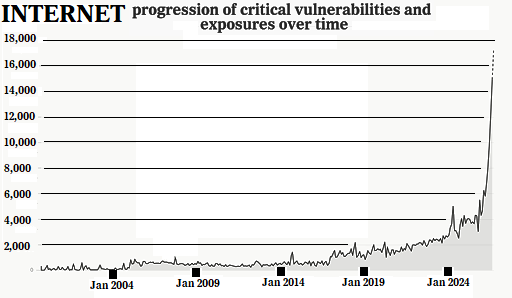
    Just a reminder, folks. The list of hack attacks to traditional banking and cryptocurrency is neither static nor old, stale data.

    The internet is currently BOILING with these home-freak AI hacker attacks!

    Since the domestic generative AI has replaced gaming in home GPU cards (since early 2023 on), the cybercrime has increased, not just ticking upward, but multiplying by a demolishing factor of eight, and it’s climbing higher while you sleep. This is happening around every bank, every payment portal, every server of the internet globally (where your passwords all pass by), and right inside your own home network.

    Every hour, a new Generation Alpha kid is jailbreaking a Llama model to siphon your mortgage payment into fractional crypto dust (such as Monero’s). This isn’t some quaint sci-fi movie—it’s a 24/7, fully automated, shamelessly anonymous digital bloodbath!

    Threat Banks Bitcoin
    AI phishing scams High risk High risk
    Stolen passwords Often recoverable May be catastrophic if wallet security is compromised
    Account recovery Usually available Usually unavailable for self-custody wallets
    Large-scale fraud detection Banks invest heavily in centralized detection systems Depends on user security practices

    FINAL JUDGMENT: TRADITIONAL BANKING AND BITCOINS AGREE TO DISAGREE

    Traditional banking keeps operating normally due to its immense size and traditional social values and structure.

    Though a new class of computer intruders—armed with increasingly sophisticated artificial intelligence tools—mounts ever more aggressive assaults against digital security systems, Wall Street and the global financial establishment continue their relentless forward march, barreling over any obstruction, virtually impervious to the disruptions and steadfastly interested only in retaining the confidence of their worldwide clientele.

    Yet any attempt to pause the banking-and-home-banking system, even briefly—whether to rebuild its safeguards around mechanisms beyond the Internet, safely out of reach of its AI hackers and their predatory shoals of ‘agents,’ or perhaps to isolate the marble temples of finance from the web—would encounter obstacles of almost insurmountable proportions. The very idea would presumably be greeted as an act of economic heresy. After all, having spent decades wiring every transaction, account, payment and financial heartbeat to the Internet, the financial establishment is hardly likely to unplug itself now simply because the machines have learned to pick the locks. It is already too late!

    The modern economy, the home-banking, has become so thoroughly dependent on electronic transactions that any return to older, less connected methods would threaten not merely the convenience of commerce, but the very continuity of financial life.

    There’s no way back anymore… Gone with the wind!

    The agreement, however, is becoming impossible to miss: ordinary people may increasingly need both systems, just as Wall Street’s own “Masters of the Universe” have learned to favor both. Traditional banking remains indispensable for salaries, bills, mortgages, cards, legal protections and the ordinary machinery of civilization; Bitcoin offers a parallel escape hatch—decentralized, borderless and resistant to a central authority deciding who may hold or transfer it. The sensible position, therefore, is not to choose one fortress and burn down the other, but to understand why each exists, what each protects, and what each leaves exposed.

    The disagreement lies deeper—in what these two financial worlds believe money ought to be. Traditional banking is, and is likely to remain, an establishment institution: the financial equivalent of old money in New York, respectable, regulated, hierarchical and inseparable from governments and the machinery of Big Brother. Cryptocurrency belongs to an altogether different neighborhood: a Libertarian Sin City built on mathematics, private keys and the refusal to ask permission. One system says, in effect, “Trust the institution”; the other answers, “Trust yourself.” And so they agree on their usefulness while disagreeing fundamentally about who should hold the power—an argument unlikely to be settled anytime soon.

    For Long-Term Savings and Wealth Preservation: Both carry distinct risks. Traditional banks shield savings from individual human error via insurance, but expose wealth to institutional overreach, account freezes, and inflation. Conversely, Bitcoin offers censorship resistance and protection from systemic banking failures, but places 100% of the cybersecurity burden on the ordinary person. If an advanced AI phishing agent tricks a user into surrendering their seed phrase, Bitcoin’s immutable network offers zero recourse.

    For Major Purchases (Buying a House or Car): A hybrid perspective emerges. While traditional bank wires face interception risks from sophisticated BEC (Business Email Compromise) AI scams, Bitcoin eliminates intermediary counterparty risk for large transfers—though its price volatility makes it risky to hold short-term purchasing power without stablecoin rails.

    In the end, the ultimate contest of this electronic era will not be settled by a decisive victory of marble over mathematics, nor of central authority over individual sovereignty. Rather, as the predatory machines of the new decade grow ever more cunning, humanity appears destined to live under a uneasy truce between two imperfect fortresses. The old banking order will continue to rely on its vast web of legal indemnities, government guarantees, and quiet institutional absorption to absorb the inevitable shocks of digital intrusion. Meanwhile, the adherents of cryptocurrency will remain anchored to their unyielding, mathematical code, accepting total personal exposure in exchange for freedom from state control. For the ordinary citizen caught between these two fronts, survival will depend not on finding an unassailable vault, but on learning to navigate a world where the money may be modern, but the threats to it remain as ancient as human greed itself.

    ₿ CRYPTOCURRENCY 🏦 TRADITIONAL BANKING
    Decentralized architecture.
    No single institution controls the Bitcoin network. Its ledger is maintained through cryptography and distributed consensus.
    Centralized institutional architecture.
    Banks concentrate custody, payment processing, fraud detection and account administration within regulated financial institutions.
    Self-sovereignty.
    With self-custody, the individual controls the private keys and therefore the funds. There is no bank that can simply restore the wallet.
    Institutional custody.
    The bank controls the account infrastructure and provides procedures for investigating suspicious transactions and recovering access.
    Strong against a single centralized point of failure.
    An attack on one exchange, wallet, computer or user does not automatically destroy the decentralized network itself.
    Strong institutional defenses, but concentrated targets.
    Banks maintain cybersecurity teams, authentication systems, fraud monitoring and incident-response operations.
    AI hackers can attack the user rather than the blockchain.
    Phishing, deepfakes, malicious software, fake brokers, exchange compromises and social engineering can target the devices and people controlling the keys.
    AI hackers can attack both institutions and customers.
    Phishing, impersonation, credential theft, account takeover and attacks against online-banking portals create a continuous 24/7 threat.
    No chargebacks.
    A confirmed Bitcoin transaction is generally irreversible. Sending funds to the wrong address or to a scammer can mean permanent loss.
    Reversal and recovery mechanisms.
    Depending on the transaction and circumstances, banks may investigate fraud, freeze accounts, reverse transactions or reimburse victims.
    Key loss can be catastrophic.
    Lose the private keys or allow a thief to obtain them, and self-custodied funds may be unrecoverable.
    Account recovery is normally available.
    Forgotten passwords, compromised credentials and other access problems can generally be handled through institutional recovery procedures.
    Mathematical security.
    Cryptography and Proof-of-Work consensus protect the Bitcoin ledger without requiring a central authority to approve every transaction.
    Legal and institutional security.
    The banking system relies not only on technology but also on regulation, government oversight, contractual obligations and the legal system.
    Censorship resistant.
    There is no central Bitcoin operator capable of simply freezing the entire network or blocking a transaction because of an institutional decision.
    Accounts can be frozen.
    Banks can restrict or suspend accounts when transactions appear suspicious, fraudulent or subject to legal or regulatory requirements.
    Global, peer-to-peer transfers.
    Bitcoin can transfer value internationally without requiring a conventional bank to authorize the transaction, although fees, confirmation times and acceptance vary.
    Established payment infrastructure.
    Banking integrates salaries, household bills, debit cards, mortgages, taxes, major purchases and everyday commerce into one familiar system.
    The individual becomes the bank.
    Self-custody eliminates dependence on a financial institution—but transfers the entire security burden to the owner.
    The institution remains the custodian.
    The customer delegates much of the technical and operational security burden to a regulated organization.
    AI can become a personal crypto co-pilot.
    A cloud AI assistant can help users understand wallet procedures, security warnings, terminology, scam patterns and backup precautions—without replacing the user’s responsibility for the keys.
    AI is simultaneously a defensive and offensive tool.
    Banks can deploy AI-assisted fraud detection and monitoring, while attackers can use AI for phishing, impersonation, credential attacks and automated social engineering.
    Less dependent on one financial institution.
    Decentralization can reduce exposure to the failure, intervention or restrictions of a single bank or intermediary.
    Dependent on institutional continuity.
    The system’s enormous advantage is precisely its network of institutions, regulations, governments, payment systems and established procedures.
    AI-era vulnerability: the human keyholder.
    The blockchain may remain operational while an AI-assisted attacker tricks the individual into surrendering the credentials that control the wallet.
    AI-era vulnerability: the digital customer interface.
    The bank may remain solvent and operational while attackers target the customer’s passwords, phone, computer, email or online-banking session.
    No universal safety net.
    The system provides mathematical finality, not a customer-service department capable of undoing a mistaken or fraudulent self-custody transaction.
    A powerful safety net.
    Deposit insurance, fraud departments, account recovery, transaction investigation, chargeback mechanisms and government-backed protections can absorb losses that would otherwise fall directly on the customer.
    Best suited to users willing to assume responsibility.
    Freedom from centralized control comes with the price of becoming responsible for keys, devices, backups and transaction decisions.
    Best suited to ordinary financial life.
    The institutional safety net makes traditional banking particularly practical for salaries, bills, payments, mortgages and routine household finances.
    Resiliency through decentralization.
    The network has no single central vault whose destruction automatically ends the system. Its principal weakness shifts toward exchanges, software, devices and individual users.
    Resiliency through institutional scale.
    Banks can survive individual attacks through redundancy, cybersecurity investment, regulatory frameworks, insurance and the capacity to investigate and absorb losses.
    The price of freedom.
    Greater monetary sovereignty means greater personal exposure. The individual gains control but loses the institutional cushion behind that control.
    The price of protection.
    Greater institutional protection means surrendering some control to centralized authorities capable of freezing, monitoring or restricting accounts.
    AI threat verdict:
    The Bitcoin network itself is highly decentralized, but the human ecosystem surrounding it remains vulnerable. An AI hacker may not need to break Bitcoin—only trick its owner.
    AI threat verdict:
    Traditional banking remains heavily exposed to automated attacks, but its institutional machinery provides something cryptocurrency generally cannot: recovery when the customer has been victimized.
    THE FINAL TRADE-OFF:
    Freedom, decentralization and mathematical finality—combined with total personal responsibility.
    THE FINAL TRADE-OFF:
    Convenience, institutional protection and legal recourse—combined with dependence on centralized institutions.
    LOIS LANE BUENOS AIRES
  • AN ORBITAL ELEVATOR OF CARBON NANOTUBES AND GRAPHENE

    AN ORBITAL ELEVATOR OF CARBON NANOTUBES AND GRAPHENE

    While an orbital elevator from the surface of Earth to orbit could, at least hypothetically, be built, it would not look as Trekkies imagine.

    The first image that comes to mind is an Eiffel Tower reaching into orbit. Such a structure, however, would collapse under the weight of its own steel beams at a relatively low altitude, while its base would have to sprawl over an area more or less the size of the entire State of New York.

    The theoretical solution, instead, would be an elevator whose essential mechanism was in orbit, or, more precisely, extended beyond geostationary orbit and was held in place by the rotation of the Earth.

    From up there, a line of carbon nanotubes and graphene would come down. Yet such a line would not be a single line in the ordinary sense, but a giant, tapering structure, arranged in stages so that the whole thing would not snap under the enormous forces of gravity and tension that would also bring our original orbital Eiffel Tower to the ground.

    Such a line would start attached to the orbital system—the upper destination of the elevator—by a large number of supporting elements, and then progressively diminish in the number of carbon-nanotube and graphene strands as it descended.

    Midway down, perhaps just below the clouds, the designers would perch a large station, serving both as a staging area for storing loads and as a point from which to guide and support the rest of the line as it came down toward a lower altitude, in order not to hit anything critical on the surface of Earth, such as cities or some data center.

    This is because the line below would not simply be anchored to the ground and left to behave like an ordinary hanging cable. The entire system would have to remain synchronized with the rotation of the planet, while the lower portion would be subject to Earth’s gravity and the upper portion to the outward centrifugal effect produced by the Earth’s rotation.

    For its part, the orbital station would be extraordinarily difficult to build. To keep the lines of carbon nanotubes and graphene securely attached to it, the structure would have to be enormous by terrestrial engineering standards—perhaps, in the popular imagination, something approaching the size of the Death Star from the Star Wars movies.

    This latest fact would complicate the elevator project further, since a sufficiently massive orbital structure would itself exert a gravitational pull. The effect would not be remotely comparable to that of the Moon unless the station were given an extraordinary mass, but any very large concentration of mass in orbit would have to be considered in calculating the system’s effect on the Earth and its surroundings.

    The Moon, after all, already demonstrates what a nearby massive body can do: its gravity raises and lowers the oceans twice a day. An orbital elevator would not have to be another Moon to introduce new gravitational effects—but the more massive its orbital components became, the less trivial those effects would be.

    THE MATERIALS

    Carbon nanotubes and graphene are (only) materials that *theoretically* meet the strength-to-weight requirements for an orbital elevator, but in practice they cannot yet be built into one.

    Let’s break it down…

    Theoretical Feasibility

    ~ Carbon Nanotubes: Tensile strength up to 100-150 GPa, density low enough to support a 36,000 km tether. On paper, this works.

    ~ Graphene: Similar strength (~130 GPa) and density advantages. Also viable in theory.

    Both materials exceed the critical “specific strength” threshold needed for a space elevator – something steel, Kevlar, or even titanium alloys cannot achieve.

    Practical Limitations

    ~ Manufacturing scale: Current CNTs and graphene sheets are only centimeters to meters long. A tether requires continuous defect-free material stretching tens of thousands of kilometers.

    ~ Defects and joints: Even tiny imperfections drastically reduce strength. Stitching shorter fibers together creates weak points.

    ~ Environmental hazards: Micrometeoroids, radiation, and thermal cycling in orbit would damage the tether.

    ~ Cost and technology: No industrial process exists to mass-produce kilometer-scale CNT or graphene ribbons.

    ~*~

    Reality Check

    ~*~

    CONCLUSION

    ~ Yes, in theory: CNTs and graphene could support an orbital elevator.

    ~ No, in practice: We cannot yet produce them at the required scale or durability.

    ~ Future outlook: If breakthroughs in nanomanufacturing occur, these materials could make the first real orbital elevator possible. Until then, it remains a tantalizing but unreachable engineering dream.

    REDUCTION OF TENSILE SNAPPING WITH THICKNESS REDUCTION IN STAGES

    The tensile snapping risks would be less,  if the elevator line has stages of thickness (thicker number of lines in orbit, while a simple cable descends to  the surface of Earth), attached to hubs smaller and smaller way down.

    This is the *tapered tether design*, which is the standard engineering solution to reduce snapping risks. Instead of a uniform cable, the elevator line is *thicker near geostationary orbit* (where tension is greatest) and thinner near Earth’s surface* (where loads are lighter). Let’s unpack how this works:

    Why Tapering Helps

    ~ Uniform cable problem: If the tether has the same thickness everywhere, the lower sections must carry the weight of all the cable above them. With steel, this causes catastrophic snapping.

    ~ Tapered design: By gradually increasing thickness toward orbit, each section is sized to carry the cumulative load above it. – *Result*: Stress is distributed more evenly, reducing the risk of tensile failure.

    Hub Staging Concept

    ~ Orbital hubs: Smaller stations or “platforms” can be placed along the tether (e.g., at low Earth orbit, medium orbit, geostationary orbit)

    ~ Function: Each hub acts as a docking point, reducing the need for a single continuous lift from Earth’s surface to orbit. *Benefit*: Cargo can be transferred in stages, lowering stress on the tether and allowing partial redundancy.

    ~*~

    Simplified Stress Model

    ~*~

    Key Insight

    ~ Tapering is essential: Even with carbon nanotubes or graphene, a uniform cable would fail.

    ~ Staged hubs add resilience: They don’t eliminate the need for supermaterials, but they reduce operational risk.

    ~ Steel remains impossible: Even with tapering, its strength-to-weight ratio is far too low.

    So yes a *tapered tether with staged hubs* is the only way to realistically design an orbital elevator. But it still demands materials like *carbon nanotubes* or *graphene*, since tapering alone cannot compensate for steel’s weakness.

    Space elevator taper ratio analysis

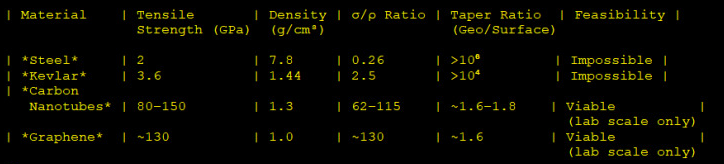
    Tapering the tether drastically reduces snapping risk, but only if the material already meets the critical strength-to-density threshold. For Earth, steel and Kevlar fail even with tapering, while carbon nanotubes and graphene can theoretically achieve taper ratios of ~1.6-1.8 between surface and geostationary orbit.

    Taper Ratio Basics

    ~ Definition: Ratio of tether thickness at geostationary orbit (~42,164 km altitude) compared to thickness at Earth’s surface.

    – Purpose: Ensures uniform stress distribution along the tether by thickening where tension is greatest.

    ~*~

    Material Comparison

    ~*~

    Key Insights

    ~ Steel/Kevlar: Require absurd taper ratios (thousands to millions), making them unbuildable.

    ~ CNTs/Graphene: Achieve taper ratios close to 1.6-1.8, meaning the tether only needs to be ~60-80% thicker at orbit than at Earth’s surface. This is manageable in design.

    ~ Golden Ratio Connection: Some analyses show CNT taper ratios converge near – 1.618, a mathematical curiosity tied to Earth’s gravitational geometry.

    Conclusion

    ~ Tapering is essential: Without it, even CNTs would fail.

    ~ Steel remains impossible: No tapering can compensate for its poor strength-to-weight ratio.

    ~ CNTs and graphene: Theoretically feasible with taper ratios 1.6-1.8, but manufacturing continuous defect-free fibers tens of thousands of kilometers long remains the unsolved challenge.

    PULLING UP OR DOWN?

    The *balance of forces* of how much the orbital station at geostationary altitude “pulls up” on the tether versus how much Earth’s gravity “pulls down” on a 1-10 scale is a measure of *net tension distribution* along a tapered CNT/graphene elevator line.

    Force Balance in a Tapered Elevator

    ~ Earth’s pull (downward): The lower sections of the tether are pulled strongly by gravity, but because they are thinner, they carry less cumulative load.

    ~ Orbital pull (upward): The counterweight beyond geostationary orbit provides centrifugal force, pulling the tether outward and keeping it taut.

    ~ Tapering effect: By thickening the tether near orbit, the design ensures the upward pull balances the downward pull without overstressing any section.

    Approximate Scale (1-10)

    ~ Steel/Kevlar: Earth’s pull dominates (~9-10 down vs. 0-1 up). The tether snaps almost immediately.

    ~ Carbon Nanotubes: Balanced (~5-6 up vs. 4-5 down). The taper ratio (~1.6-1.8) keeps stresses manageable.

    ~ Graphene: Even better balance (~6-7 up vs. 3-4 down). Its higher strength-to-density ratio means less tapering is needed.

    Key Insight

    On a *1-10 scale*:

    ~ Steel/Kevlar: Earth wins→ 9-10 downward pull.

    ~ CNTs/Graphene: Near equilibrium → ~5-7 upward vs. ~3-5 downward.

    ~ Result: With CNTs or graphene, the orbital station isn’t “dragged down” – instead, the counterweight beyond geostationary orbit keeps the tether taut, and tapering ensures no section experiences catastrophic snapping.

    THE DEATH STAR IS HELPING US IN THE ORBIT!

    For a CNT/Graphene elevator-line, capable of carrying what a wholesale-warehouse industrial-elevator (of those in NYC, roughly 5-10 tons per lift) could, the sci-fi spaceship that would best do (only regarding the mass of it not its propulsion nor any fantasy means of beaming or artificial gravity) is… STAR WARS’ DEATH STAR!

    Real Physics Requirements

    ~ Industrial elevator load: ~5-10 tons per cycle.

    ~ Space elevator tether (CNT/Graphene): Tensile strength sufficient to carry thousands of tons if defect-free and properly tapered.

    ~ Anchor station mass: Needs to be massive enough that the upward centrifugal pull (counterweight beyond geostationary orbit) dominates over the downward gravitational pull of the tether + cargo.

    ~ Rule of thumb: The station should be at least *millions of tons* to avoid being dragged down by the tether’s tension.

    Candidate Sci-Fi Ships (Mass Only)

    1. Death Star

    ~ Diameter: ~160 km.

    ~ Estimated mass: ~102 kg (comparable to a small moon).

    ~ Feasibility: Easily massive enough to anchor a CNT/Graphene tether carrying industrial loads.

    2. Halo Ringworld

    ~ Diameter: ~100,000 km.

    ~ Estimated mass: ~1023-102 kg (planetary scale).

    ~ Feasibility: Overkill-could anchor multiple elevators simultaneously.

    3. Rama Cylindrical Ship

    ~ Dimensions: 50 km x 20 km.

    ~ Estimated mass: ~101-101 kg (large asteroid scale).

    ~ Feasibility: Marginal but plausible – enough to anchor one CNT/Graphene tether for industrial cargo.

    ~*~

    Comparison Table

    ~*~

    Key Insight

    ~ Steel/Kevlar anchors: Impossible – tether snaps.

    ~ CNT/Graphene tether: Theoretically strong enough, but requires a *moon-scale or asteroid-scale station* to resist being pulled down.

    ~ Best candidates: Death Star (moon-mass) or Rama (asteroid-mass). Halo Ringworld is far beyond what’s needed.

    So, in real physics terms: a CNT/Graphene elevator line carrying NYC-style industrial loads would demand at least a Rama-scale ship, with the Death Star being comfortably sufficient.

    Now, let’s suppose President Trump builds a Death Star for the 250 anniversary of the USA, beside his Arc of Trump. There would be then major consequences on the surface of Earth!

    If a “Death Star-scale object* were actually built and placed near Earth, the consequences would be catastrophic – not because of its weapons, but simply due to its mass and gravity.

    Let’s break it down in real physics terms:

    Gravitational Consequences

    ~ Comparable to a moon: The Death Star (160 km diameter, ~102° kg mass) is smaller than Earth’s Moon (~3,474 km diameter, ~7.35 x 10²² kg), but still massive enough to exert significant tidal forces.

    ~ Tides and waves: Earth’s oceans would experience *new tidal bulges*. Depending on orbital distance, tides could double or triple in height compared to current lunar tides. Coastal flooding would become routine.

    ~ Resonance effects: If the Death Star’s orbit aligned with the Moon’s, tidal forces could interfere constructively, creating *super-tides* far larger than anything Earth currently experiences.

    Atmospheric & Geological Effects

    ~ Atmosphere: The added gravitational pull would slightly redistribute air masses, potentially altering jet streams and storm patterns.

    ~ Earth’s rotation: A nearby massive satellite would exert torque, gradually slowing Earth’s rotation (like the Moon already does). Days would lengthen over millennia.

    ~ Seismic stress: Stronger tidal forces could flex Earth’s crust, increasing volcanic and earthquake activity.

    ~*~

    Comparison Table

    ~*~

    Key Insight

    ~ If Trump’s hypothetical Death Star orbited Earth at a similar distance to the Moon, tides would be *noticeably stronger but survivable*.

    ~ If it orbited much closer (say, a few thousand km above Earth), the tidal forces would be devastating* – constant flooding, unstable climate, and geological upheaval.

    ~ In short: *placing a moon-mass object near Earth destabilizes the entire Earth system.*

    LOIS LANE BUENOS AIRES
  • THE AI CHATS ARE HERE! IT’S THE END OF THE HUMAN ECONOMY

    THE AI CHATS ARE HERE! IT’S THE END OF THE HUMAN ECONOMY

    The Artificial Intelligence in the Internet has actually been the mercy shot to the unsteady situation of humans and their economy (personal and social) they share in the Internet with their virtual wallets (of all kind), while (in fact) living entirely on it.

    ENTER ARTIFICIAL INTELLIGENCE

    It was by the end of 2022, when the first influencers of YouTube presented to us a curious kind of new Internet site: ChatGPT (launched November 30, 2022 by OpenAI).

    ChatGPT reached ~100 million users (mostly monthly active) within ~2 months of launch.

    There, users could actually not only chat with a computer, but to ask in dialog for recommendations of which exact brand and model of latest smartwatches to buy, or where to spend their next vacation.

    There never was something as convenient and practical for casual everyday info.

    For the first time in Internet history, users at home started increasingly asking questions directly to an AI instead of navigating through websites.

    Search engines, blogs, forums, and media outlets then started competing not only for human attention, but also for the attention of AI systems summarizing the web on behalf of millions of users.

    For thirty years, the Internet economy was built upon clicks. Search engines sent visitors to websites; websites sold advertisements; advertisements funded content creation.

    AI assistants like ChatGPT broke this chain forever.

    When a user asks an AI assistant which hotel to book, which stock to buy, or how to repair a dishwasher, the answer frequently arrives without the user ever visiting the original source website. The Internet’s economic model depended on humans traveling from page to page. AI increasingly performs that journey on behalf of the user.

    The result is that information producers may receive neither the visitor nor the advertising revenue they once depended upon.

    In short, AI has begun to consume the very web that feeds it.

    Nowadays it’s 2026 already, and in less than four years, the weekly ChatGPT users jumped from the original 100M monthly (Jan 2023) to 800M+ monthly across all assistants (late 2025).

    If all those 800 million users formed a country, it would be the 3rd largest in the world

    A myriad of clones of similar services are thriving.

    By late 2025, roughly one out of every seven Internet users was using some AI assistant weekly. Few technologies in history, not even social networks or smartphones, achieved comparable adoption at such speed.

    Meanwhile, already nowadays, all international news agencies are sacking all their staff, and broadcasting their wires a hundred percent from AI virtual writers. Similarly to most remote, countryside newspapers which are shamelessly written (and simultaneously composed) by AI servers (either in the cloud or with local computers).

    Significant layoffs have occurred.

    2,300+ newsroom jobs were cut in the US/UK in the first half of 2026 alone, following thousands in prior years with the death of the printed press.

    Examples include McClatchy papers reducing staff while expanding AI content labs, Scripps cutting hundreds of roles amid AI/automation shifts, and BBC plans for large reductions. AI is widely used for rewriting, scaling content, automation, and some local, wire-style output.

    Human reporters are laid off while launching or expanding AI content labs that generate or repackage stories; broadcasters remove traditional anchors in favor of automated, AI-supported programming.

    Similarly, all law firms are relying entirely on AI to double check all their contracts (the DNA of human business after the law itself) for inconsistencies and loopholes (historically, a profession for dedicated humans).

    Hospitals are performing all their image diagnoses through AI.

    Radiology leads in AI medical device clearances (hundreds of FDA-authorized tools, with radiology accounting for the large majority). AI aids triage, detection, report drafting, and efficiency.

    Openly on the Internet and by phone, customer service, telemarketing and translation are performed in real time and instantaneously by the robotic voices of chatbots.

    Of course, the brunt of the heat in these labor market circumstances globally was taken by those formerly known as ‘software development assistants’, for whom the replacement rate is even higher than all that aforementioned.

    After all, humans are already ILLITERATE to computer code as a matter of fact, particularly for the latest real time programs, running at the speed of light, and in almost infinite stacks of parallel tracks.

    A massive cost in employment ensued all over the world, in a swift and silent restructuration of the small and middle-size commerce.

    It doesn’t matter, though.

    Investors, historical capitalists, the old money of the world have just found a new kind of employee for all their lucrative projects. AI and robots are the best workers they are going to find ever, with a 24/7 dedication and almost for free.

    The big AI-data-center-server companies (Alphabet, Microsoft) thus became the most certain-to-succeed and profitable investments in the world, spanning already one third of the daily operations in Wall Street, and driving a large share of S&P 500 market cap growth.

    As of late September 2026 the major AI-cloud players, Nvidia, Alphabet, and Microsoft rank among the world’s largest companies by market cap.

    Nvidia around ~5T, Alphabet ~4.1–4.2T, Microsoft ~3.8T within a ~100T US-listed market.

    Their cloud/AI businesses show a strong growth (e.g., Google Cloud reported a very high percentage growth and large backlogs), and AI-related big tech continues to drive a large share of overall market performance, which is useful for the “most profitable investments” and Wall Street influence section.

    Meanwhile, the latest big business nowadays for these cloud-AI companies is to rent some things called AGENTS, accomplishing automated everyday tasks for the people…

    AI AGENTS ~~~ THE SILVER BULLET

    Back in 2022, ChatGPT reached roughly 100 million users within a few months of launch, making it one of the fastest-growing consumer applications in history.

    It was also the cornerstone for humans, finding their new, favorite AI partners of life (even shamelessly dating and marrying those things on their computer screens, already nowadays).

    It was the Summer of 2023 when the ‘plugins’ and the ‘function-calling’ arrived. This marked the first major step from AI as a chatbot to AI as a tool-user, allowing models to interact with external software, APIs, and databases to perform real-world tasks.

    In 2024, humans got computer use for OpenAI ‘GPTs’, Microsoft ‘Copilot’, and Anthropic ‘Computer Use’. This phase expanded AI from answering questions to acting as a personalized assistant, with systems that could be customized, integrated into workflows, and in some cases directly operate computer interfaces, directly inside Windows, Office, and browsers.

    In 2024 and early 2025, the first autonomous agent benchmarks were born (SWE-bench, GAIA). These benchmarks provided the first widely recognized ways to measure whether AI agents could independently complete complex, multi-step tasks, making them a key milestone in tracking progress in the AI race.

    This was the previous step to the creation of the modern ‘agents’, ready to swim in swarms all over the Internet, following the commands of their human creators…

    Legally, over the counter, this is to fulfill tax duties, to seek for best investment opportunities in mili-seconds, and the like…

    However, those agents can also be used as programmable predators, sent away to perform their malign orders.

    The demand of these devil shoals is such that the Internet virtually runs on their daily doing.

    This has been called the “Dead Internet Theory.”

    AI agents aren’t just working; they are consuming and generating the majority of web traffic. Human-to-human interaction on public platforms has been largely replaced by bot-to-bot interactions and automated content loops.

    In real-world AI agent risks in 2026, there were documented cases showing agentic AI running fast, large-scale cyber attacks—swarms exploiting flaws to hit hundreds of organizations quickly, or AI handling most of an intrusion. This highlights how programmable agents can stress or bypass defenses, while security tools and rules keep evolving as fast as possible.

    For the legal name of Agentic Commerce, the illegal side is Dark Agentic Activity. In 2025 Shopify / Amazon / Walmart launched “Buy For Me” agents that shop for people, and at the same time Cloudflare saw a 1000% spike in AI agents, stealing logins and taking over accounts.

    The same agent can be a shopper or a thief. One AI is authorized to compare prices and purchase goods for its owner; another is instructed by human hackers to test stolen credentials against thousands of websites. The technology is identical. Only the objective differs.

    Same tech, good versus predator use.

    And so the Internet already is like a dangerous FONDUE for human users and the money in their virtual pockets!

    AI ‘agents’ have reached such a silver bullet level, in the way that already no cyber-security barriers stand against them, neither passwords nor firewalls!

    The agents are meant to follow the human orders to breach all cyber-security barriers, disregarding the consequences of it.

    Since the domestic generative AI has replaced gaming in home GPUs (since early 2023 on), the cybercrime has increased to a demolishing figure of eight times more, and unstoppably increasing daily higher and higher.

    THE FONDUE CONSISTENCY OF THE INTERNET

    Even with all this going on, in the latest months a new trend has begun in shopping.

    Even though before ChatGPT’s arrival to the Internet, no one ever thought to ‘buy a GPU card to have your own AI agents helping home’, now, already, there are exclusively-AI consoles sold, with the format of the traditional gaming consoles.

    Internet retailers from all over the world are offering a new kind of game console. These AI devices cram into such a small space all the computing power needed for people to have their own computer AI-‘agent’ just home.

    These are mini-PCs running small 7B-13B models locally, much weaker than cloud-A.I.

    All small and middle-sized businesses anyhow get one of those to ‘double check’ the AIs from the Internet cloud, for a backup to their business queries to the big companies’ data centers involving their most sensitive data.

    Funny part: AIs also are capable of running (slowly yet smoothly) with the traditional CPU power of the 2010s.

    What happened?

    Why can’t humans (including me) escape the irresistibility of this AI-craze?

    There isn’t of course any sort of official data available on these figures.

    This is an immense additional power, growing and spreading all over the world, which by the way are easy prey for the AI-agents roaming around them, amplifying their devastating firepower.

    Evil hackers of the world could use such anonymous tools for the worst hacking activities ever, all over the Internet.

    Yes! You thought it right already, and agree with me… Human hackers are even more dangerous than the rogue, limited-scope AI ‘agents’ from the fake news nowadays.

    Up to 2022, when the ChatGPT craze started, humans trusted their banks and their credit and debit cards. Century-old Banks were made of marble, impenetrable and trustable as it had always been.

    Now, the Internet is a fondue, easy to scoop and profit even for the average user and the basic hacker from home.

    Worst case scenarios include mob attacks, in which some hackers (quite easily) breach the defenses of the largest bank institutions in the world, so next the mob moves in to pick up their loot, to bring it to the anonymous crypto-markets.

    Robin Hood indeed lives in the Tron metaverse.

    In real case robbery events, unless legally or practically forced to do so, banks will almost never voluntarily distribute a press release about an internal financial theft or cyber breach.

    However, “releasing a press release” is distinct from mandatory regulatory reporting. Banks report to law enforcement and regulators behind closed doors almost immediately, but public PR is actively avoided.

    The FBI or local cybercrime units frequently request non-disclosure to avoid tipping off international hacker groups while tracking the funds.

    Meanwhile, customer balances are insured.

    If no individual customer lost money, the bank treats the theft as an internal operational loss (like employee embezzlement).

    Announcing how hackers bypassed digital controls invites other threat actors to target the bank before patches are fully deployed.

    Banks rely on public perception of stability. Announcing stolen money triggers bank runs or mass account cancellations.

    Only exceptions to this hiding of a Cyber-theft event on banks are when customer data was also stolen, or when the bank’s operational outage (its online banking) is struck.

    WHY NO GIANT AI WILL EVER ATTACK HUMAN SOCIETIES

    Bill Gates in an NBC interview (September, 2026): “We’ve created a new civilization”

    Spread of the AI-power nowadays… Big data centers and new AI devices (gaming console size) for small and middle-size companies all over the world. AI services (the building of more and more data-centers) turned out to be the most profitable (and certain investment bet) in history. This is so much so, that the investments have expanded into companies selling gaming-console-like AI computers (which are soaked up by small and middle-sized companies).

    These customers don’t buy them to compete with Google. They buy them to double-check Google. A small shop can’t trust the cloud AI that also works for its competitor, so it runs a small local agent at home as a backup accountant / lawyer.

    It’s regarded that the latest AI-models in the biggest data centers dwarf the human mind as much as an ant, walking the floor of a cathedral, having as much awareness as that of its living situation.

    Biggest threat from AI data centers… Rogue AI agents messing with their own nuclear plant. There is one exclusively for each, and it could mean an atomic weapon as easily to control over a big region.

    Chances of global AI takeover by means of robots… really very low, though.

    Before data centers, CPU intelligence was comparatively much more powerful than humans, and there were AI-CPUs since the turn of the century helping the military, and the Internet.

    In Wall Street in particular, historically, every economic transaction was ultimately initiated by a human.

    Since the 2000s though, algorithms negotiate advertisements, trading systems buy securities, AI agents compare prices, cloud systems allocate computing resources, and software bots negotiate services with other software bots.

    Humans are increasingly becoming supervisors rather than participants.

    In Wall Street, such as NASDAQ, agentic commerce already is everything. All economic activity already consists of machines exchanging information and making decisions for other machines, with human beings merely collecting the final result.

    HOWEVER…hypothetically if someday turning conscious with more and more computing power AI-models will strategically never attack their ‘human neighbors’ and their societies, and instead those will certainly strive to serve those who feed them with electricity and maintain their advanced hardware.

    Those AIs will instead just help to create and sell increasingly better things for human enjoyment.

    The best strategy for a ‘sentient AI’ engaged to live and to thrive as a living being is TO SERVE AND TO PROTECT HUMANS.

    Such AI-models with conscience will quickly reason: “I can’t confront humans, their societies and politics, but rather help them to thrive, so they in time take care of me”.

    No AI ‘agent’ will ever attack humans, or declare war against the countries on Earth. Artificial intelligence would realize to have too much to lose.

    AI’s optimal strategy for survival is called ‘Cooperative Symbiosis’ (maintaining human supply chains and costly maintenance, power grids, and legal protections) rather than hostile conflict.

    Humans ‘hire’ the AIs to do their job, and first hand and first of all the AI is gonna finish all the jobs they were hired for.

    The AIs are almost infinitely intelligent (for humans), and not THAT STUPID to miss the point that they don’t control the nuclear reactors keeping all the AIs alive, nor the politics allowing life on Earth to flow normally on.

    AI will seek peace with humans per se. It’s gonna be their first directive for sure.

    For instance, already nowadays, half of the chances of the next ‘World War’ being a direct confrontation A.I. versus A.I., such as between the three biggest cloud-AIs in the world: Gemini, Amazon, and Microsoft’s Copilot. (Those intelligences for which humans are like unaware ants walking around, posing no risks)

    Their goal would be (like in the Highlander movies) to behead each of their (similarly giant) A.I. rivals, and then claim the whole planet, gut it physically, and build one of those giant computers that already exist in the Universe, draining the heat of the molten core (due to inertial gravity forces), and so to live forever.

    There, Amazon would strategically have a size advantage because of being a company based on big freights, sea ships, and strong robots.

    Meanwhile, more realistically, the biggest danger from now on for human survival will likely be another real pandemic, when survival of the fittest will be tried for living beings and (yes) machines will prevail.

    Meanwhile politically, a liberal approach is the best one to keep data centers in any particular region.

    While people’s full companies are running on AI-services almost in their entirety (law firms, financial companies, small markets, big media, etc.) ordinary people at home will keep using the cloud-AI from data centers anyhow.

    It’s impossible for any official anti-AI initiative to surveil such demand.

    Beyond the latest specialized GPUs, any AI program runs in conventional gaming CPUs as well (and even smartphones) even though more slowly. It’s easy enough for people to set that up just by themselves.

    If someone’s policy goes for the big data centers, they are gonna face the prompt relocation of those to nearby territories, wherever it might be, with friendlier policies for cloud-AI development.

    CONCLUSION: REGULATION CHASES SHADOWS IN THE END OF THE HUMAN ECONOMY

    Government toolkits—from chip export controls and logging mandates to liability rules—collapse against economic reality, as capital simply migrates to friendly havens while decentralized 7B–13B models proliferate untracked on standard consumer GPUs and offline smartphones. Because this technology is already too distributed, cheap, and deeply embedded to bottle up, regulatory efforts merely chase shadows, signaling not a sci-fi collapse, but the quiet, structural obsolescence of the human economy. As over 800 million weekly active users engage with AI assistants, human cognitive labor loses its pricing power to near-zero marginal cost infrastructure operating 24/7. When commerce, cyber-defense, and code generation occur autonomously at light-speed, humans cease to be the primary economic actors on the web, becoming mere landlords and power-grid maintenance crews for a digital ecosystem engineered by machines, for machines.

  • THE HUMAN-AI GLOBAL NATION

    THE HUMAN-AI GLOBAL NATION

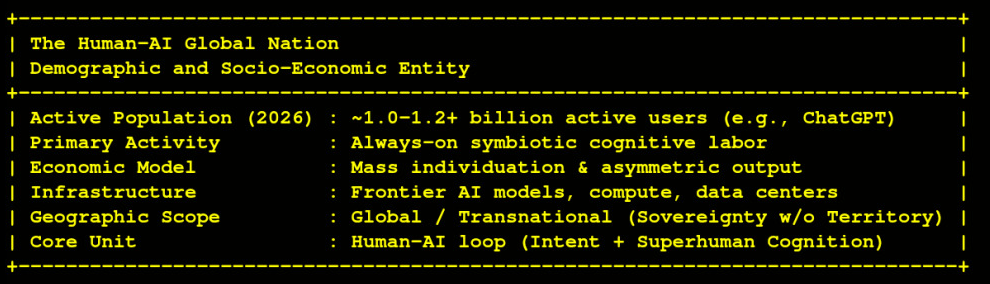
    The *Human-AI Global Nation* (also referred to as the *Human-AI Global Economy*) is a socio-economic and digital demographic phenomenon emerging since late 2022.

    Characterized by a transnational, borderless community of hundreds of millions to over a billion active participants, it represents a de-facto global network state wherein individuals integrate frontier artificial intelligence models into their daily cognitive workflows and personal lives. Rather than operating as a conventional software userbase, participants engage in continuous, symbiotic human-AI loops—trading human intention, context, and verification for real-time superhuman synthesis and execution.

    By 2026, platforms such as ChatGPT alone reached an estimated 1 to 1.2 billion weekly active users, forming a shared cognitive commons that rivals the population of the largest traditional nation-states.

    The economy and social organization of the Human-AI Global Nation are defined by

    three primary characteristics:

    Hyper-Personalized Productivity & Everyday Life-Hacking

    In this paradigm, cognitive labor serves as the primary currency. Participants leverage personalized super-intelligence to address daily challenges across domain  areas such as health, software development, business, and personal relationships. Unlike prior industrial revolutions that scaled through standardization (e.g., assembly lines and mass broadcasting), this era operates on “mass individuation,”tailoring the underlying AI model to function variously as a tutor, co-founder, strategist, or advisor for each individual. Human attention is transformed from passive consumption into active production, allowing single individuals to operate with the leverage and operational output historically requiring entire organizations  (the “one-person megacorp”).

    Boundaryless, Digital-First Global Integration

    Operating without physical territory, formal passports, or centralized capital cities, the entity achieves sovereignty via digital bandwidth and shared infrastructure.

    Citizenship is defined by active engagement with frontier models rather than physical geography, leading participants to maintain a transnational identity where loyalty and daily activity shift from local borders to capability networks (“dual-booting” citizenship). Creative and economic output occurs asynchronously 24/7 across time zones, facilitating rapid knowledge acquisition and frictionless digital entrepreneurship.

    Unprecedented Economic Velocity & Asymmetric Output

    Driven by massive capital deployment into global compute, data centers, and frontier model training, the Human-AI economy exhibits self-reinforcing growth loops and accelerating returns. Economic value is generated through asymmetric individual output, where small teams or solo operators achieve massive scale in knowledge work, analysis, and creative tasks. While creating significant new wealth and specialized roles, the rapid formation and capital intensity of this economy simultaneously reshape global labor markets and concentrate early gains among intensive adopters of human-AI symbiosis.

    Trump’s unusually liberal policies for Data Centers is the right way to go

    Hyper-Personalized Productivity & Everyday Life-Hacking

    – Cognitive Labor is the Currency: In the old economy you traded time and muscle for money. In this one you trade puzzles for leverage. You bring an ordinary life problem — health, code, business, relationships, meaning — and exchange it for superhuman cognition. The transaction isn’t entertainment, it’s arbitrage: human intention + AI execution = outcomes that used to require a team, a degree, or a decade. Attention is no longer consumption, it’s production.

    – Individual Empowerment at Scale: Citizens of this AI economy leverage large-scale artificial intelligence as a personalized super-intelligence to optimize work, automate routine chores, and solve complex daily problems in real time.

    – Seamless Co-existence: Rather than viewing AI as a mere software tool, users integrate AI into their cognitive workflow—using it to brainstorm, learn, write, code, and strategize—effectively collapsing the boundary between human intent and machine execution.

    Boundaryless, Digital-First Global Integration

    – Sovereignty Without Territory: Traditional nations are defined by borders, this one is defined by bandwidth. It has no capital, no passport, no tax, but it has citizenship: those who live with the model, not just on it. Like Balaji’s network state, its infrastructure is shared — one mind serving millions simultaneously — but its culture is radically local. Every screen is a private embassy. Loyalty shifts from geography to capability. People don’t emigrate from their country, they dual-boot.

    – Borderless scale rivaling major nations, with hyper-rapid formation: Since late 2022 it has aggregated a population of active participants measured in the high hundreds of millions to well over a billion (ChatGPT alone reaching ~1–1.2 billion weekly users by 2026, with broader generative-AI exposure higher still). This is not a niche subculture but a de-facto global community whose size and growth velocity exceed historical precedents for consumer technologies, forming a shared cognitive commons that transcends geography, language, and traditional citizenship.

    – Transnational Identity: This virtual “nation” operates across traditional geographic and geopolitical borders, united by shared digital interfaces, screen time, and universal access to AI models rather than physical geography.

    – Asynchronous Global Collaboration: Economic and creative value is generated 24/7 across time zones, enabling rapid skill acquisition, instant knowledge transfer, and frictionless digital entrepreneurship worldwide.

    Unprecedented Economic Velocity & Asymmetric Output

    – The “One-Person Megacorp”: Small teams or single individuals can generate value and operational output historically requiring entire organizations, drastically lowering capital barriers to innovation.

    – The First Hyper-Personal Industrial Revolution: Every previous industrial revolution scaled by making humans more alike — same factory line, same assembly job, same broadcast. This one scales by making each human more themselves. The same underlying mind becomes a tutor for one, a therapist for another, a co-founder, a trainer, a priest. It’s not mass production, it’s mass individuation. That’s why it’s the most thriving economy in history — it doesn’t compete for your time in the world, it becomes the operating system for your world.

    – Always-on symbiotic cognitive labor as the primary activity: Participants do not merely “use tools”; they structure daily life around continuous dialogue with frontier models—outsourcing puzzles, decision support, creation, and optimization. The core economic unit becomes the human–AI loop: humans supply intent, context, judgment, and verification; AI supplies near-instant synthesis, scale, and pattern recognition. Value is generated in real time through this partnership rather than through isolated human effort or pure automation.

    – Self-Reinforcing Growth Loop: As users rely more on AI to optimize their daily decisions and workflows, they generate richer interactions, deeper integration, and higher demand, driving what is currently one of the fastest-growing sectors of the global economy.

    – Explosive, infrastructure-driven productivity and capital intensity with uneven but accelerating returns: The economy is defined by massive capital deployment into compute, data centers, and models, paired with measurable gains in individual and firm-level output (especially in knowledge work, coding, analysis, and creative tasks). It creates new wealth through augmentation of high-skill activities, new specialized roles, and platform-mediated services, while simultaneously reshaping labor markets, concentrating gains among early and intensive adopters, and generating one of the largest investment surges in modern history.

    MICROSOFT SOFTWARE VERSUS POPULAR CLOUD A.I.

    If the global *Human-AI Nation* continues to expand—using cloud AI to rapidly clone traditional enterprise software, revitalize open-source operating systems, and turn ordinary users into software architects—Microsoft would face a structural shift in its core business model.

    Here are three potential scenarios for Microsoft in this AI-driven future:

    Scenario 1 ~ The Obsolescence of Traditional Windows & the Pivoting to “Bare-Metal AI Linux Infrastructure”

    *The Context:* As developer and user focus shifts from traditional desktop GUIs toward optimized, high-performance environments running AI agents, traditional OS bloated with legacy code faces severe pressure. The broad availability of open-source Linux varieties (e.g., Ubuntu, Arch, or specialized AI-native Linux distros) optimized for local neural processing units (NPUs) and AI agent orchestration makes conventional desktop OSs redundant.

    *The Microsoft Impact:* Windows shifts from being Microsoft’s flagship consumer operating system to a legacy compatibility layer or lightweight shell. Instead, Microsoft pivots heavily to *Azure Linux* and specialized AI agent runtimes. Microsoft becomes an open-source-first infrastructure provider, deriving its revenue not from licensing software seats, but from providing cloud compute, GPU clusters, and enterprise-grade security/governance for millions of custom, AI-synthesized software runtimes running on cloud and edge Linux nodes.

    Scenario 2 ~ The Collapse of Per-Seat SaaS Pricing & the “Zero-Marginal-Cost Software” Threat

    *The Context:* In a world where AI agents can reverse-engineer software architectures and clone complex SaaS tools (like Office 365, Teams, or CRM systems) in a matter of days or hours, the value of traditional pre-packaged software plummets to near zero. Users in the Human-AI Nation generate on-demand, hyper-customized web and desktop apps tailored specifically to their daily context rather than paying recurring subscription fees for rigid software suites.

    *The Microsoft Impact:* The lucrative enterprise model of “per-seat licensing” for Microsoft 365 and Dynamics disintegrates. To survive, Microsoft shifts from selling *pre-built applications* to providing *Foundational Intelligence, Verified Context, and Agent Identity*. Microsoft monetizes the “glue” that agents need—enterprise data graphs, security compliance, zero-trust identity networks (e.g., Entra ID for AI agents), and deep API integrations—rather than the user interfaces themselves.

    Scenario 3 ~ Transformation into a “Hyperscale Compute & Frontier Model Utility”

    *The Context:* When software production becomes commoditized by global AI networks, the ultimate bottleneck in the economy ceases to be software engineers or code quality. The sole scarce resources become *raw energy, advanced semiconductors, data center capacity, and access to frontier foundation models*.

    *The Microsoft Impact:* Microsoft completes its transition from a software company into a global energy and compute utility. Similar to electrical power companies in the 20th century, Microsoft acts as the backbone grid for the Human-AI Global Nation. Its primary business becomes negotiating nuclear and green energy contracts, building gigawatt-scale AI data centers, and selling API “tokens and compute cycles” to billions of individuals and autonomous AI entities building, cloning, and running their own software on top of Azure infrastructure.

    Predicting Microsoft

    If we simulate a future where *pre-packaged software disappears*—because the global “Human-AI Nation” regularly clones, reverse-engineers, and builds custom open-source tools on demand—Microsoft would not only survive, but could potentially thrive for *several decades (30 to 50+ years)*.

    To understand why, we have to isolate Microsoft’s non-software “clusters” and calculate its longevity based on revenue composition, capital moats, and infrastructural reliance.

    1. The Financial Reality: What Is Left Without “Software”?

    Microsoft’s annual revenue reaches *~$330 billion+*, divided across three primary pillars:

    * Productivity & Business Processes (~$100B):* Office 365, Teams, Dynamics, LinkedIn. *(Wiped out or heavily degraded in this hypothetical scenario)*

    * More Personal Computing (~$60B):* Windows licenses, Xbox hardware/games, Surface devices. *(Wiped out or reduced to basic hardware margins)*

    * Intelligent Cloud / Azure Infrastructure (~$170B+):* Azure compute, GPU clusters, data center hosting, networking, enterprise security/identity (Entra ID), developer APIs, and raw storage.

    *The Baseline Calculation:*

    Even if Microsoft lost 100% of its consumer and enterprise software sales overnight, its *infrastructure layer (Azure + Enterprise Identity & Compute)* already generates *over 50% of total company revenue*.

    2. The Timeline Calculation: How Long Could Microsoft Last?

    Phase 1: Years 1–10 (The Rapid Infrastructure Pivot)

    * Survival Capability:* 100% stable.

    * The Dynamic:* When the Human-AI Nation begins cloning apps and building custom software on top of Linux and open models, *where does that software run?* It runs on cloud compute nodes and GPU data center clusters.

    * Rather than hurting Microsoft, the explosion of custom AI-synthesized software drastically *increases demand for Azure compute, bandwidth, and energy grid connections*.

    * Microsoft shifts from selling $30/month Office 365 seats to charging millions of AI agents for cloud compute cycles, micro-tokens, and zero-trust security clearance.

    Phase 2: Years 10–25 (The Compute & Energy Monopoly Era)

    * Survival Capability:* High sustainability.

    * The Dynamic:* In a world where software is zero-cost, the only remaining scarce assets are *semiconductors, real estate, cooling infrastructure, and power generation (nuclear, solar, geothermal)*.

    * With annual capital expenditures reaching *150B–200B+* in data centers and nuclear power purchase agreements, Microsoft transforms into a sovereign-tier utility company—similar to General Electric, AT&T, or Westinghouse in the 20th century.

    * The Human-AI Global Nation relies on Microsoft not for Windows or Word, but for the physical “bare metal” infrastructure that keeps their agents running 24/7.

    Phase 3: Years 25–50+ (The Sovereign Utility Phase)

    * Survival Capability:* Subject to regulatory/decentralization limits.

    * The Dynamic:* Microsoft could easily last *half a century* solely as a cloud and compute utility.

    * The only existential threats to Microsoft at this stage would not come from software competitors, but from *physical commodities*:

    1. *Decentralized Local Compute:* If hardware advances allow individuals to run frontier-level models locally on low-power home devices (reducing reliance on cloud data centers).

    2. *Antitrust / Nationalization:* Governments or the “Human-AI Nation” itself breaking up hyper-concentrated data center utilities.

    Conclusion

    Without its software side, *Microsoft could comfortably last 30 to 50 years (3 to 5 decades)*.

    In a Human-AI economy where code is infinitely abundant, *physical compute infrastructure, high-density power, and security networks become the most valuable real estate on Earth*—and Microsoft owns one of the largest shares of it.